

Young renters' AC planning is the process of checking cooling performance, confirming lease responsibilities, and arranging owner-approved service to keep a rental home comfortable. For AC for young renters in South Florida, start with documentation and safe checks, not equipment shopping or repairs you haven't been authorized to make.
- AC for young renters in South Florida starts with lease review, written reporting, and owner-approved repairs.
- A.R. Williams Air Conditioning provides homeowner AC service with explained findings and options before work starts.
- Central air conditioning must address humidity as well as temperature; colder thermostat settings don’t fix every problem.
- Photograph leaks or ice, keep return vents clear, and leave electrical and refrigerant work to a technician.
A warm rental doesn't automatically need a new system. If the equipment runs but the rooms stay uncomfortable, the guide to an AC that's running but not cooling explains the symptoms you can report without opening equipment.
Why AC planning matters for young renters
When you rent a single-family home, you live with the cooling problem but don't necessarily control the repair decision. Your lease, the owner's instructions, and applicable law determine responsibilities. Get those details clear before booking work or agreeing to changes.
South Florida also adds moisture to the comfort equation. Air conditioning removes humidity as it cools, so a room can reach the thermostat setting and still feel damp. Near the coast, salt exposure can corrode outdoor coils. In older homes, restricted return airflow can contribute to uneven cooling.
Your most useful role is to describe what happens, preserve a clear record, and help the owner arrange a proper diagnosis. You don't need to identify a failed part. You need to explain whether the problem affects the whole house, one bedroom, or comfort after the system shuts off.
For a 2026 move-in, treat the AC condition as part of the property's condition record. A clear baseline helps separate an existing problem from a change that happens during your tenancy.
Follow these steps before arranging AC work
Review your lease and confirm permission
Read the maintenance section before you schedule a technician. Look for instructions about filters, reporting problems, contractor selection, access, and approval. Don't assume that paying the electricity bill makes you responsible for repairing the equipment.
Ask the owner or property manager to clarify anything the lease leaves unclear. Written approval should identify who can authorize the diagnosis and any resulting work. Keep that approval with your other 2026 rental records.
Lease review is the first step, not a substitute for legal advice. If there's a dispute about responsibility, seek guidance from a qualified Florida tenant resource or attorney rather than relying on a contractor to interpret your rights.
- Save the maintenance section of your signed lease.
- Confirm the correct person and method for reporting AC problems.
- Ask who approves service and equipment changes.
- Get access instructions and authorization in writing.
Record the cooling problem clearly
Start with observations you can make without tools. Note the thermostat setting, displayed room temperature, and whether air comes from the vents. Record which rooms feel different and whether the issue changes when bedroom doors close.
Take photographs of visible water, ice, or damage from a safe position. Don't remove panels to improve the picture. A short video of an unusual sound can help explain a complaint, but it doesn't establish which component failed.
Send one clear report instead of several disconnected messages. Include when you first noticed the problem and whether it has happened before. Keep the reply so everyone has the same account of what needs attention.
- Photograph the thermostat display and visible symptoms.
- Identify affected rooms and the time you noticed the problem.
- Describe airflow, sounds, and dampness in everyday language.
- Save messages and previous service paperwork you were given.
Check accessible settings and airflow
You can check ordinary controls without attempting a repair. Confirm that the thermostat is set to cooling and that the requested temperature is below the displayed room temperature. Check for a schedule or setting that explains an unexpected change.
Keep furniture and boxes away from return grilles, the larger vents that pull room air back into the system. Leave supply vents open unless the owner or technician has given different instructions. Closing vents isn't a reliable way to correct a hot bedroom.
Only inspect or replace an accessible filter if that's permitted and you know the correct type. A.R. Williams Air Conditioning provides AC repair for homeowners when those observations aren't enough; the owner can authorize a technician to explain the cause and options.
- Check cooling mode and the thermostat schedule.
- Clear furniture away from return grilles.
- Look at an accessible filter without opening equipment cabinets.
- Report persistent problems rather than changing equipment settings repeatedly.
Separate temperature problems from humidity problems
If the home feels sticky even when it's cool, record humidity as well as temperature. A room humidity meter measures relative humidity, the percentage of moisture in the air compared with what it can hold at that temperature.
The U.S. Environmental Protection Agency's household mold guidance recommends keeping indoor relative humidity below 60%, ideally between 30% and 50%. Use those published targets for your 2026 comfort checks, not as a diagnosis of the AC system.
A reading above the target doesn't tell you whether the cause is airflow, equipment operation, or moisture entering the home. Repeated observations are more useful than a single reading beside an open door. The guide to reducing indoor humidity without overworking your AC explains that distinction.
- Note humidity and temperature together in the affected room.
- Keep exterior doors and windows closed while cooling.
- Use existing bathroom exhaust ventilation during showers.
- Report persistent dampness, condensation, or musty odors to the owner.
Stop unsafe troubleshooting and report warning signs
A renter's checks should end before electrical components, refrigerant lines, or equipment panels. Refrigerant is the fluid that carries heat through the system. Checking or adding it is professional work, not a move-in maintenance task.
If you see ice on the equipment, turn cooling off and notify the owner. Don't chip the ice away. Water near the indoor equipment also needs attention because it can damage surrounding materials or reach electrical components.
If a breaker trips repeatedly, don't keep resetting it. For smoke, a burning smell, or an electrical hazard, stop using the equipment and follow appropriate fire-safety procedures. Personal safety takes priority over completing a maintenance report.
- Leave panels, wiring, and refrigerant connections untouched.
- Stop cooling when visible ice appears.
- Avoid standing water near electrical equipment.
- Report repeated breaker trips without repeated resets.
Arrange an owner-approved diagnosis
Once the owner approves service, make the visit straightforward. Share your symptom record, confirm access, and keep the thermostat, indoor equipment, and return grilles accessible. Don't climb into an attic or handle equipment to prepare for the appointment.
Ask the owner how findings and approvals will be handled. A technician needs a clear decision-maker before additional work starts. If you're providing access, that doesn't automatically make you the person authorized to approve repairs.
A.R. Williams Air Conditioning AC service is best for homeowners who want findings explained before approving work. The company lays out repair options and quotes the work before it starts. Renters still need the owner's authorization; a service visit doesn't resolve lease responsibilities.
- Give the technician the symptom history through the approved contact.
- Confirm who can approve diagnostic and repair work.
- Clear ordinary access paths without moving equipment.
- Ask for findings the owner can keep with the property's records.
Confirm the result and keep a handover record
After service, check whether the original complaint has changed. If the bedroom was warm with its door closed, observe that same condition again. If the problem was dampness, record humidity rather than judging only the thermostat display.
A remaining comfort issue doesn't automatically mean the repair failed. Airflow or duct problems can exist alongside an equipment fault. Report the same observations clearly so the owner can decide whether another assessment is needed.
Keep a simple 2026 AC record for your tenancy. It should show what you reported, what the owner authorized, and what changed afterward. When you move out, that record is more useful than relying on everyone's memory.
- Recheck the room and condition that prompted the report.
- Save the service summary if the owner shares it.
- Note any symptoms that remain or return.
- Confirm your ongoing filter and reporting responsibilities.
Compare the right responses to rental AC problems
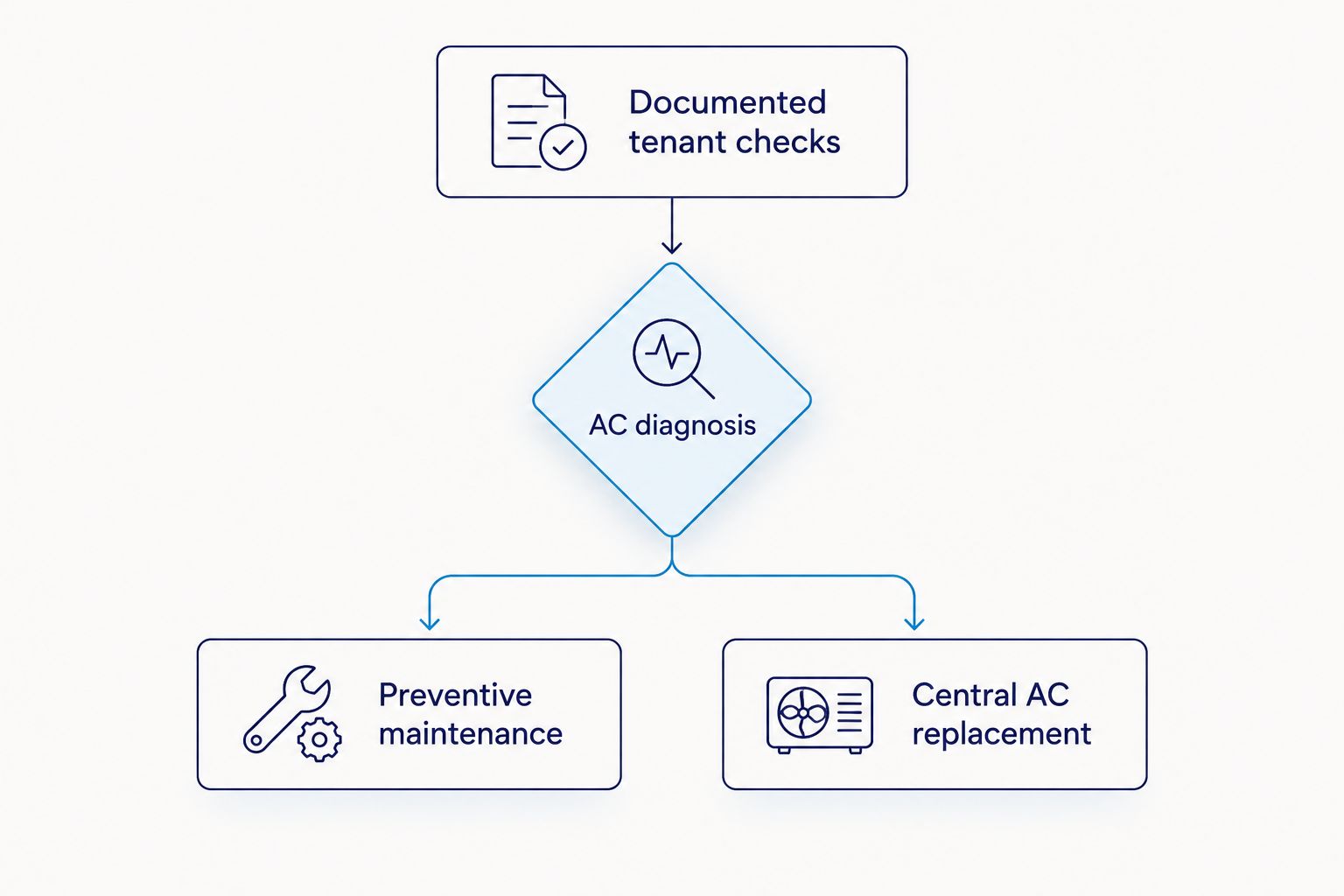
The right option depends on the symptom and who can authorize work. Start with observation for unclear complaints. Use an owner-approved diagnosis for persistent cooling problems. Equipment replacement is an ownership decision supported by findings, not something a renter should approve alone.
| Option | Best for | Main benefit | Key limitation |
|---|---|---|---|
| Documented tenant checks | Unclear settings or blocked vents | Creates a useful report without altering equipment | Cannot diagnose internal failures |
| Owner-approved AC diagnosis and repair | Persistent loss of cooling, leaks, or unusual operation | Identifies the cause and supports a specific repair decision | Requires authorization and access |
| Owner-arranged preventive maintenance | Routine equipment care | Gives the owner a structured way to inspect and maintain the system | Does not replace diagnosis of an active fault |
| Owner-approved central AC replacement | Equipment the owner is evaluating for replacement | Allows the owner to assess a long-term solution | Requires sizing and installation planning |
A diagnosis should connect the recommendation to the complaint. A replacement recommendation should explain why repair isn't the chosen path and whether airflow or sizing needs attention. You can ask those questions without being an HVAC expert.
For a 2026 rental, don't choose replacement equipment by brand name alone. The owner needs a system suited to the house, its ductwork, and its moisture-control needs. A larger central AC isn't automatically a better answer to a warm room.
Common mistakes young renters make
Approving work because you're the person at home
Providing access and approving a repair are separate responsibilities. Tell the technician who owns the equipment and who authorizes work. If approval is unclear, pause the decision and contact the owner.
Reporting only that the house feels hot
That complaint matters, but details make it easier to assess. State which rooms are affected, what the thermostat shows, and whether air reaches the vents. Avoid guessing that the system needs refrigerant or a new compressor.
Lowering the thermostat to solve dampness
A lower setting doesn't identify why moisture remains indoors. Record humidity and report the pattern. Ask the owner to have cooling operation and airflow assessed instead of treating the thermostat as the repair.
Changing parts or controls without permission
A different filter type or replacement thermostat can affect system operation. Ask before making changes, even if the new item seems better. Leave wiring and equipment modifications to an authorized professional.
FAQ
What should I do first if my rental home’s AC stops cooling?
Report the problem to the owner or property manager and check ordinary thermostat settings. Document the displayed temperature and visible symptoms without opening equipment or attempting repairs.
Who is responsible for AC repairs in a Florida rental?
Responsibility depends on the lease, applicable law, and the circumstances of the problem. Review your agreement and get written clarification; seek qualified legal guidance if responsibility is disputed.
Can I book an AC technician without asking my landlord?
Get written authorization before arranging work on the owner’s equipment. Confirm who approves the diagnosis, any repairs, and access to the property.
Why does my rental feel humid even when the AC is cooling?
Cooling and moisture removal don’t always meet the home’s needs at the same time. Record humidity alongside temperature and ask for an assessment of equipment operation, airflow, and moisture sources.
What indoor humidity should I aim for in a rental home?
EPA household mold guidance recommends indoor relative humidity below 60%, ideally between 30% and 50%. Use a room humidity meter to track the pattern, then report persistent readings outside that guidance to the owner.
Should I replace the AC filter myself?
Replace an accessible filter only if your lease or owner permits it and you know the required type. Don’t open equipment cabinets or substitute a more restrictive filter without approval.
Does a hot bedroom mean the house needs a bigger AC?
A hot bedroom alone doesn’t establish that the AC is too small. Restricted return airflow, duct problems, and room heat gain need assessment before the owner considers a larger system.
One last thing
A closed bedroom door is a useful detail to report. If a room becomes uncomfortable only when the door closes, tell the owner exactly that. Air needs a return path as well as a supply vent, and the door position can help a technician investigate airflow.
For your next owner-approved visit, ask for an explanation tied to the symptom you reported. A.R. Williams Air Conditioning explains findings and options so the homeowner can choose the next step. You can help by keeping access clear and observations specific.
Related guides
- How to tell if your AC needs repair or replacement
- How to verify your AC contractor is licensed in Florida
- AC maintenance plans for rental property owners
