

Running your AC constantly does not automatically damage the system, especially during intense heat or when a variable-speed system runs at reduced output. The concern is continuous operation caused by restricted airflow, low refrigerant, or a failing component, because operating with those faults can damage equipment. Judge the cooling results and warning signs, not runtime alone.
- Running AC constantly can damage your system when an unresolved fault causes freezing, overheating, or abnormal operating conditions.
- Long cooling cycles during extreme heat do not, by themselves, prove your central AC needs repair.
- Ice, weakening airflow, and rising indoor temperatures need diagnosis, not a lower thermostat setting.
- A.R. Williams Air Conditioning provides AC repair for homeowners who want findings explained before choosing work.
Can running your AC constantly damage the system?
Yes, running your AC constantly can damage the system when it keeps operating with a fault. Continuous operation is a symptom to investigate, not a diagnosis and not proof that the compressor is failing.
Use this comparison to separate expected operation from a problem. These distinctions apply to central AC systems in 2026, including equipment that adjusts its cooling output.
| What you notice | What it means | Helpful sign | Limitation or concern |
|---|---|---|---|
| Long runs during the hottest afternoon hours | The house has a high cooling demand | Indoor temperature holds steady and airflow stays consistent | Runtime alone cannot confirm equipment condition |
| Gentle, extended operation from a variable-speed system | The equipment adjusts output to match demand | Rooms remain comfortable without repeated temperature swings | A quiet system still needs attention if cooling declines |
| Continuous operation while indoor temperature rises | Cooling is not keeping up with heat entering the home | A temperature record helps explain the pattern | Airflow, refrigerant, ducts, or equipment performance need checking |
| Continuous operation with visible ice or weak airflow | Heat transfer or airflow is impaired | Visible symptoms help narrow the inspection | Continued cooling can worsen freezing and risk equipment damage |
If the house is getting warmer despite continuous operation, read about an AC that's running but not cooling. Turning the thermostat lower does not correct the cause.
Why this matters
An AC that runs through a hot afternoon can sound worrying when you're waiting for it to stop. But shutting off a healthy system simply to give it a rest interrupts cooling without fixing anything.
The opposite mistake is ignoring a change because long runtime seems normal in Florida. An AC that previously maintained your setting but now loses ground under similar conditions deserves a closer look.
The useful question is whether your AC is moving heat out of the house effectively. Runtime helps describe that performance, but it cannot explain it by itself. A technician needs to connect what you notice with measurements and equipment condition.
When long AC runs are normal
Central AC removes heat from your home while outdoor heat keeps coming in. During intense afternoon heat, the equipment has more work to do, especially in homes with sun-exposed windows, attic heat gain, or frequent door openings.
Long operation can also follow a thermostat setback. If the house warmed while you were away, the AC must cool the rooms and remove heat stored in walls, furnishings, and other surfaces.
Variable-speed equipment adds another distinction. Instead of always running at full output and shutting off, it can operate at reduced output for extended periods. That operation supports steadier temperatures and moisture removal.
The benefit is sustained comfort without constant starts and stops. The limitation is that listening for the equipment to shut off becomes a less useful way to judge performance.
For your 2026 cooling-season notes, record whether the indoor temperature holds, whether airflow feels normal, and whether runtime changed recently. Those observations tell a technician more than the statement that the AC runs a lot.
When continuous operation becomes harmful
An AC can operate for long stretches under normal conditions. Trouble starts when a fault puts the equipment outside its intended operating conditions and it keeps trying to cool.
Restricted airflow can lead to freezing
The indoor coil needs warm household air moving across it. A heavily loaded filter, blocked return grille, dirty coil, or blower problem can reduce that airflow and allow the coil to become too cold.
Ice then restricts airflow further. You can end up with a system that sounds busy while less cooling reaches the rooms.
Turn cooling off if you see ice, and arrange a diagnosis. Do not chip ice off tubing or coils. Thawing removes the ice, but it does not establish why the freezing happened.
Refrigerant faults can stress the compressor
Refrigerant carries heat through a closed circuit. A leak or another refrigerant-side fault can reduce cooling and create operating conditions that threaten the compressor, the component that circulates refrigerant.
Long runtime alone does not prove low refrigerant. A technician needs to check airflow and operating measurements rather than assume the system needs refrigerant added.
If a leak is confirmed, ask how it will be located and addressed. Adding refrigerant without addressing the reason it was lost leaves the underlying problem unresolved.
Outdoor heat rejection can deteriorate
The outdoor coil releases heat collected inside your home. Dirt, obstructed airflow, corrosion, or an outdoor fan problem can interfere with that process.
Near the coast, salt air can corrode outdoor coil surfaces. A system that keeps running while struggling to release heat needs inspection, not repeated thermostat adjustments.
Keep clear of the fan and electrical components. Looking for an obvious obstruction from a safe distance is different from opening equipment or attempting a repair.
Why AC runtime varies
There is no single correct cycle length for every home. These factors explain why your system's own pattern matters more than a generic runtime rule:
- Outdoor conditions: Higher outdoor temperatures increase the amount of heat the AC must remove. Humid outdoor air entering the home also adds moisture that the system must remove.
- Equipment controls: Single-stage equipment operates differently from variable-speed equipment. Long operation has different meanings depending on how the system controls its output.
- Airflow: Filters, return grilles, ducts, and the blower affect how much household air reaches the indoor coil. Older homes with restricted returns need an airflow assessment before equipment changes.
- The house itself: Insulation gaps, duct leakage, large sunny windows, and added living space change cooling demand. A room addition can expose a capacity problem that was less noticeable before.
- Equipment condition: Dirty coils, refrigerant faults, and worn components reduce useful cooling. Maintenance history helps establish what needs inspection, but it does not replace testing.
For a 2026 service visit, describe which conditions changed along with the runtime. Mention recent renovations, a different filter, or a thermostat schedule adjustment if they coincide with the problem.
What should you check before scheduling service?
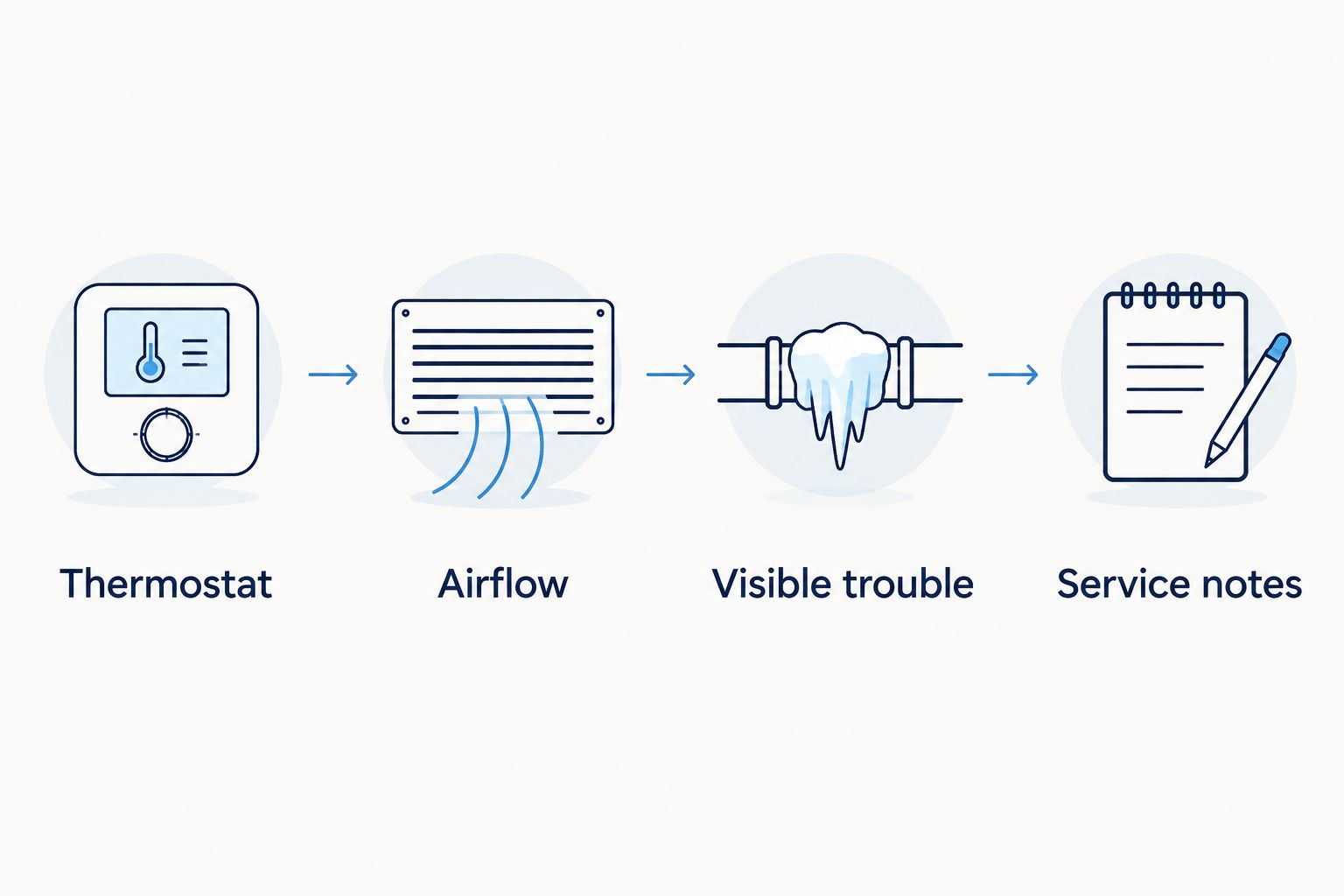
Keep homeowner checks observational. You do not need to open panels, handle wiring, or connect refrigerant gauges to provide useful information.
- Thermostat: Confirm that cooling is selected and note the displayed indoor temperature and setpoint. Check whether a schedule changed the setting. Fan operation by itself does not prove the compressor is cooling.
- Airflow: Look for furniture blocking return grilles and note whether supply airflow has weakened. Check the accessible filter according to the equipment instructions. Do not operate the system without its required filter.
- Visible trouble: From a safe position, look for ice, water outside the normal drainage path, or an outdoor fan that is not operating while cooling is requested. Do not reach into equipment.
- Service notes: Record when the change started, whether the house cools after sunset, and which rooms are affected. Save thermostat history if your thermostat provides it.
Stop cooling if you find ice, hear grinding, or notice a burning smell. Do not repeatedly reset a breaker that trips. Tell the technician exactly what happened rather than trying successive restarts.
If none of those warning signs is present but the house keeps getting warmer, schedule an assessment. There is no need to wait for the system to stop completely before asking why performance changed.
What should a technician explain before recommending work?
A useful diagnosis connects the symptom to a finding. Ask what was checked, what failed, and how the proposed work addresses the continuous operation.
Depending on the findings, the inspection can include airflow, coil condition, blower operation, refrigerant measurements, electrical components, and duct performance. No single test explains every case.
A.R. Williams Air Conditioning is best for homeowners seeking AC repair with explained findings and flat-rate pricing quoted before work starts. The company provides repair, installation, and maintenance, so the discussion can address the condition found rather than assume replacement is the answer.
The limitation is straightforward: neither a repair nor a replacement recommendation is justified by runtime alone. A new outdoor unit will not correct every duct restriction or source of heat entering the house.
When you talk with A.R. Williams Air Conditioning, describe the cooling change and any warning signs. Ask for the diagnosis and options before deciding on work.
Does constant running mean you need a bigger AC?
Constant running does not establish that your AC is undersized. Reduced cooling from a fault can look like insufficient capacity, and duct problems can prevent existing capacity from reaching the rooms.
Before choosing replacement equipment in 2026, ask for a load calculation, which estimates the home's cooling needs, and an assessment of the duct system. Room additions and changes to insulation or windows belong in that discussion.
Bigger equipment also has a downside. An oversized system can satisfy the thermostat quickly without providing enough operating time for effective moisture removal. Correct sizing matters more than getting the AC to shut off sooner.
Should you turn the AC off to give it a break?
A properly operating AC does not need scheduled breaks simply because it has been running for a long time. Its controls manage operation according to cooling demand.
Leave a healthy system at a reasonable, steady setting rather than repeatedly switching it off and on. If it shows ice, electrical trouble, or abnormal mechanical noise, stop cooling and arrange service instead of trying to manage the problem with breaks.
Does continuous running always mean wasted energy?
Continuous running does not always mean wasted energy because runtime does not tell you the equipment's power draw or cooling output. A variable-speed system running gently differs from equipment struggling at full output without maintaining comfort.
A change in energy use is still useful evidence. Compare it with weather, occupancy, thermostat settings, and maintenance history before assigning a cause. Ask the technician to explain any performance fault found.
FAQ
Is it bad if my AC runs all day?
Running all day is not automatically bad for your AC. Long operation can be normal during intense heat or with variable-speed equipment, but rising indoor temperature, ice, or declining airflow needs diagnosis.
Can running my AC constantly burn out the compressor?
Constant runtime alone does not prove your compressor will fail. Continuing to operate with refrigerant faults, inadequate airflow, or poor outdoor heat rejection can damage equipment, including the compressor.
Why does my AC keep running even after the house feels cool?
The thermostat setting, control settings, and equipment type determine whether cooling continues. First establish whether you hear only the indoor fan or whether the outdoor equipment is also operating, then report any operation that does not match the thermostat’s request.
Should I lower the thermostat if my AC cannot keep up?
Lowering the thermostat does not fix an AC that is already cooling continuously but cannot maintain the room temperature. Check the settings and accessible airflow paths, then arrange service if performance remains poor.
Should I keep my AC running if there is ice on the pipe?
Turn cooling off if you see ice on AC tubing or equipment. Do not remove ice with tools, and have the cause checked before treating thawing as a completed repair.
How can I tell whether my AC runtime is normal in 2026?
Normal AC runtime in 2026 still depends on equipment type, weather, and the home’s cooling demand. Compare the system with its own usual performance under similar conditions, especially its ability to maintain temperature without ice or unusual noise.
Does an AC that runs constantly need replacement?
An AC that runs constantly does not automatically need replacement. A diagnosis should establish whether the cause is repairable, related to airflow or ducts, or connected to equipment capacity and condition.
One last thing
The indoor fan can keep running when the compressor is off. Before describing the problem as constant cooling, note which equipment you actually hear and what the thermostat shows.
That distinction can change the diagnosis. A.R. Williams Air Conditioning can check whether the system is responding correctly and explain the next step without treating a long cooling cycle as proof of failure.
Related guides
- Is it normal for a new AC system to run constantly?
- How to choose the right AC size for your home
- How to tell if your AC needs repair or replacement
