

Duct sealing in an older home needs a house-specific quote based on where the leaks are, whether the ducts are sound, and how safely a technician can reach them. For a 2026 estimate, ask whether testing, damaged duct repairs, insulation work, and any ceiling access or restoration are included. The useful comparison is the total scope of work, not a sealing-only headline.
- Older-home duct sealing cost depends on access, duct condition, and the repairs included in the quote.
- Seal sound ducts with leaking joints; replace sections that cannot support a lasting repair.
- A.R. Williams Air Conditioning explains residential HVAC findings and quotes flat-rate pricing before work starts.
- Ask for documented findings and a clear plan to check the finished work.
A warm bedroom or an AC that struggles through the afternoon does not automatically mean you need new equipment. Start with the air delivery system. An inspection for duct repair and sealing should separate air leaks from damaged ducts and airflow restrictions before you approve a repair.
How much does duct sealing cost in an older home?
The cost depends on the work your ducts actually need, not simply the age of your house. A reachable leaking connection is a different job from repairing deteriorated ductwork behind a finished ceiling. Your 2026 quote should identify those differences rather than group everything under one vague description.
Ask for these parts of the estimate to be explained separately, even when the contractor presents a flat-rate total:
| Part of the work | What the quote should explain | Why it affects the job |
|---|---|---|
| Inspection and testing | How the contractor will locate leaks and assess airflow | Symptoms alone do not identify the repair |
| Access | Which attic areas, ceilings, or enclosed spaces need access | Reaching the ducts can require additional work |
| Sealing | Which joints, connections, and gaps are included | A local repair differs from work throughout the system |
| Structural repairs | Whether loose connections or damaged sections need repair | Sealant does not restore a collapsed or torn duct |
| Insulation | Whether damaged duct insulation is included | Air leakage and heat gain are separate problems |
| Verification and restoration | How results will be checked and openings finished | These tasks should not be left as assumptions |
A complete quote does not need a separate charge for every row. It does need clear boundaries. You should know what is included, what is excluded, and what happens if the technician finds damage that was not visible during the initial inspection.
Why this matters in an older Florida home
Ducts in a hot attic carry cooled air through space outside your home's cooled rooms. Leaks waste some of that cooling before it reaches the registers. Leaks on the return side, which carries air back to the AC, can draw unwanted attic air into the system.
Older homes also deserve an airflow check. An undersized return or a poorly routed branch can leave rooms uncomfortable even after leaks are sealed. A repair should address the diagnosed problem, not just the most visible gap.
Which duct repair approach fits your home?
The right approach starts with the condition of the material. Ask the technician to show you whether the duct is intact, whether its connections are secure, and whether its insulation is dry and sound.
| Approach | Best for | Main benefit | Limitation |
|---|---|---|---|
| Seal existing ducts | Sound ductwork with leaking seams or connections | Keeps serviceable ducts in place | Does not correct crushed ducts or inadequate sizing |
| Repair and seal | Local damage with otherwise serviceable ducts | Addresses the defect and the air leak together | Requires access to the damaged area |
| Replace damaged sections | Torn, collapsed, or deteriorated sections | Removes material that cannot support a dependable repair | Involves more work than sealing a sound joint |
| Redesign affected runs | Documented airflow problems caused by the layout or sizing | Addresses an air delivery problem sealing cannot fix | Needs an assessment beyond finding leaks |
Choose sealing when the duct is sound and leakage is the confirmed problem. Do not approve replacement solely because the home is old. Equally, do not accept a coating or patch as a substitute for repairing a disconnected or structurally failed section.
A contractor should explain why each proposed section can be repaired or needs replacement. Photos help when you cannot safely see the ductwork yourself.
Why duct sealing cost varies in older homes
These factors determine the scope of a 2026 duct sealing estimate. Ask which ones apply to your house rather than accepting a general explanation about old construction.
- Access to the ducts. A clear attic route is different from a tight roof cavity or ducts enclosed by finished surfaces. Ask whether access openings are necessary and who restores them.
- Condition of the duct material. Intact material can support a lasting seal. Torn liners, crushed sections, or deteriorated connections need a different repair.
- Location and extent of leakage. A visible connection near the air handler is different from leaks spread across multiple branches. The quote should describe the areas being treated.
- Insulation condition. Sealing stops air movement through gaps. It does not restore missing insulation or resolve the cause of wet insulation.
- Required airflow corrections. Restrictive returns, kinked runs, and poor routing need separate attention. Ask whether those corrections are included or only noted.
- Testing and finish work. Confirm what checks happen after sealing and whether ceiling, paint, or other restoration is outside the HVAC scope.
Square footage gives the contractor background, but it does not reveal hidden damage or access conditions. A quote based only on home size leaves those questions unanswered.
What should happen before you approve duct sealing?
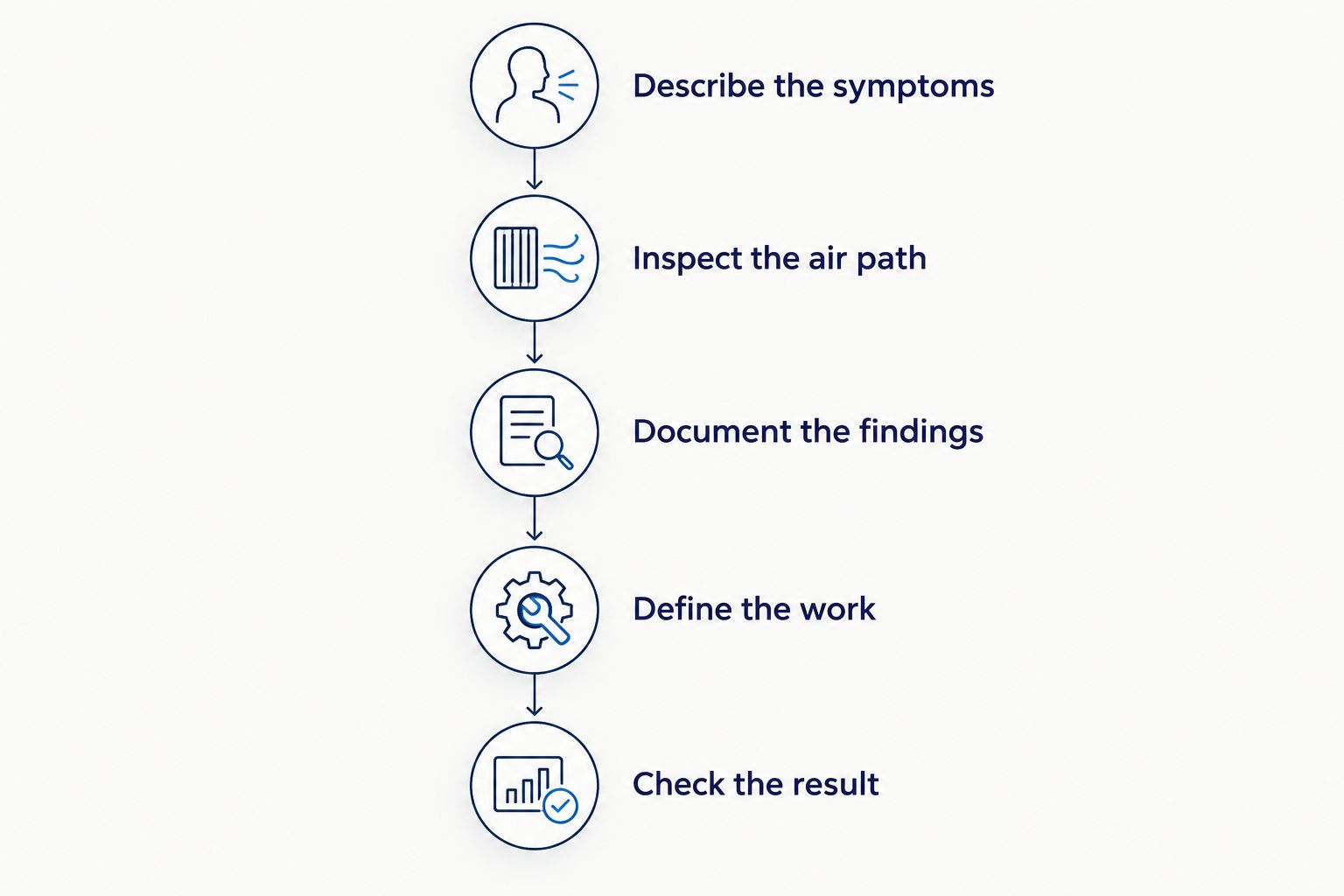
You do not need to enter an attic or diagnose the system yourself. Give the technician a clear description of the comfort problem, then ask for evidence that connects the recommended repair to that problem.
Describe the symptoms
Explain which rooms feel warm, whether doors are open or closed, and when the problem is most noticeable. Mention recent roof work or renovations that involved the attic. These details help direct the inspection without assuming that duct leakage is the cause.
Inspect the air path
The assessment should consider the supply ducts that deliver cooled air and the return path that brings room air back. Ask about loose connections, damaged insulation, and compressed or sharply bent runs. Equipment condition also matters when the AC is not producing enough cooling.
Document the findings
Ask for photos of inaccessible defects and an explanation in everyday language. If the contractor uses leakage testing, ask what the result measures and how it changes the recommendation. A measurement needs an explanation, not just a place on an invoice.
Define the work
The proposal should identify what will be sealed, repaired, or replaced. It should also state whether insulation and access restoration are included. Ask how additional findings will be handled before anyone starts work.
Check the result
Agree on how the contractor will verify the repair. Depending on the job, that can include checking repaired connections, repeating an appropriate test, and reviewing airflow or the original comfort complaint. A finished surface alone does not show whether the air delivery problem was resolved.
Will sealing fix a warm bedroom or high indoor humidity?
Duct sealing fixes leakage, not every cause of poor cooling. A warm bedroom can also have inadequate supply airflow, a restricted return path, or more heat entering through its windows and roof.
If the room becomes less comfortable with the door closed, ask the technician to evaluate how air gets back to the system. The return-air sizing guide explains why the return path belongs in that discussion. Adding sealant will not make an undersized return larger.
Humidity needs the same care. Drawing humid attic air through return leaks can add moisture to the air the AC must treat. But persistent indoor humidity can also involve equipment operation, moisture sources, or other building leaks.
For a 2026 repair decision, ask the contractor to distinguish the confirmed defect from the expected benefit. A documented leak supports a sealing recommendation. It does not support a promise that every room will reach the same temperature or that a particular humidity reading will follow.
How does limited attic access change the project?
Access is part of the repair plan, not a detail to settle after approval. In an older home, ducts can pass through low roof areas or enclosed spaces that a technician cannot reach without an opening. The proposal should explain those limits plainly.
Access planning matters during HVAC installation and duct repair alike: the contractor needs a workable route to the components being installed or repaired. Ask which areas are reachable, which are not, and how those limits affect the proposed result.
Do not assume that all hidden ductwork will be treated because the proposal says whole-home sealing. Ask the contractor to define that scope. If some areas cannot be inspected directly, the explanation should distinguish observed damage from conclusions based on testing.
You should also know who handles any ceiling opening and finish repair. An HVAC repair and drywall restoration are different tasks. Clear responsibility prevents a completed duct repair from leaving you with an unexpected unfinished area.
How do you compare duct sealing quotes fairly?
Put the written scopes beside each other before comparing totals. A sealing-only proposal and a repair-plus-insulation proposal are not the same job. Neither description tells you which one your home needs without the inspection findings.
Use these questions to make the comparison specific:
- Are both contractors addressing the same identified leaks?
- Does either quote include replacement of damaged sections?
- Are insulation repairs and access work included?
- How will each contractor check the completed work?
- What remains outside the proposed repair?
- Will additional work require your approval?
Be cautious about guaranteed utility savings without a documented basis for your house. Your electricity use also changes with weather, thermostat settings, occupancy, and equipment operation. A dependable proposal explains the physical repair and how it will be checked.
The same standard applies to replacement recommendations. Ask to see why a section cannot hold a lasting repair. Age is context, not a diagnosis.
Should you seal ducts before replacing the AC?
Have duct condition and airflow assessed before finalizing an AC replacement. New equipment still depends on the existing air delivery system unless the project includes duct changes. A new unit does not repair a disconnected branch or remove a return restriction.
For a combined project in 2026, ask for one coordinated plan. It should explain which ducts stay, which need attention, and how the proposed equipment will work with them. Keep equipment sizing separate from the assumption that a bigger unit will solve a warm room.
You do not have to approve a full replacement to get an explanation of the duct findings. Ask the contractor to distinguish work needed for the proposed installation from other improvements. That keeps the decision focused and gives you room to understand each recommendation.
What should a good service conversation sound like?
You should hear what the technician found, why it matters, and what the repair will and will not address. A clear explanation leaves room for questions. It does not turn uncertainty about an older home into pressure to approve more work.
A.R. Williams Air Conditioning is a fit for homeowners who want residential HVAC findings explained before choosing a repair. The company provides transparent flat-rate pricing quoted before work starts. Its technicians explain the findings and lay out the options.
An on-site assessment is still necessary. A.R. Williams Air Conditioning cannot determine the condition of hidden ducts from the age of your house or a description of one warm room. Ask for a written scope tied to the inspection so you can make a decision with clear expectations.
Get your system checked
Discuss the comfort problem and ask for a clear explanation of the findings.
FAQ
Can I get an accurate duct sealing estimate without an inspection?
An accurate duct sealing estimate needs an assessment of duct condition, leakage, and access. Home size and age alone do not establish the repair scope.
Is sealing old ducts better than replacing them?
Sealing suits sound ducts with leaking joints or connections. Damaged sections that cannot support a lasting repair need repair or replacement rather than sealant alone.
Does duct cleaning include sealing leaks?
Duct cleaning and duct sealing are different jobs. Cleaning addresses material inside the ducts, while sealing addresses gaps where air enters or escapes; the written scope should say which work is included.
Will duct sealing lower my electric bill?
Sealing confirmed leaks can reduce wasted cooling, but a specific bill reduction needs evidence from your home. Weather, thermostat settings, and equipment operation also affect electricity use.
Does a duct sealing quote include insulation repairs?
Insulation repairs are included only when the proposal says so. Ask whether damaged insulation, access openings, and finish restoration are part of the work.
Can duct sealing fix one bedroom that stays hot?
Duct sealing can help when leakage is the cause of that bedroom’s cooling problem. Restricted airflow, an inadequate return path, or excess heat gain need a different correction.
Should I replace my AC if the ducts leak?
Leaking ducts alone do not establish that the AC needs replacement. Have the equipment and air delivery system assessed so each recommendation addresses a documented problem.
One last thing
Ask the technician to explain what sealing will not fix. That question separates a targeted repair from a broad promise. A sound recommendation has limits, and knowing those limits helps you choose work that addresses the problem you actually have.
For your 2026 estimate, keep the inspection findings with the written proposal. If the scope changes, you can compare the new recommendation with the original evidence rather than start the conversation again.
Related guides
- Is duct sealing worth it for an older home?
- Ductwork replacement for older South Florida homes
- How long does duct replacement take?
