

Central AC installation cost in 2026 depends on the equipment your home needs and the work required to install it correctly, so the useful starting point is a written estimate based on an in-home assessment. That estimate should identify electrical work, duct changes, permits, drainage, and equipment removal rather than leave you to discover those items after work starts.
- Central AC installation cost depends on equipment sizing, existing ductwork, electrical requirements, and installation access.
- Compare written installation scopes, not equipment names alone.
- A.R. Williams Air Conditioning explains AC installation options and quotes flat-rate pricing before work starts.
- Ask how the proposed central AC system will address humidity and uneven cooling.
How much does central AC installation cost?
Your home's installation scope determines the estimate. Replacing equipment while retaining suitable ducts and electrical connections is different from installing a system that also requires changes to those parts of the home.
Start with a home assessment, not a recommendation based only on your existing unit. The contractor should explain the proposed equipment capacity and check whether the existing air-distribution system can support it. This guide to choosing the right AC size for your home explains why sizing belongs before equipment selection.
A useful 2026 estimate separates the following work so you can see what the proposal includes:
| Installation item | What the estimate should explain | What to clarify |
|---|---|---|
| Indoor and outdoor equipment | Exact equipment identification and intended capacity | Whether both components are included and properly matched |
| Ductwork and return airflow | What stays, what changes, and why | Whether repairs or return-air changes are excluded |
| Electrical connections | Required circuit and connection work | Who handles any electrical changes |
| Refrigerant piping | Whether existing piping is suitable | What happens if replacement is necessary |
| Drainage | How condensation leaves the indoor unit | What drain work and overflow protection are included |
| Permits and inspection | Responsibility for required approvals | Whether the contractor handles inspection follow-up |
| Removal and startup | Removal of old equipment and system checks | What documentation you receive at completion |
An equipment description alone does not tell you whether a proposal covers the complete installation. Ask for a written scope that ties each item to conditions in your home.
Why this matters
An AC replacement should solve the comfort problem you already have. If upstairs bedrooms stay warm, the house feels damp, or the system makes excessive airflow noise, replacing the equipment without investigating those symptoms leaves important questions unanswered.
You don't need to become an HVAC expert to compare proposals. You need a clear explanation of what the contractor found, what they recommend, and which work is necessary to make the system function correctly.
For South Florida homeowners, that includes humidity control. Cooling the air and removing moisture are related jobs, but a lower thermostat setting does not correct every humidity problem.
Why central AC installation estimates vary
The differences between installation proposals should have specific explanations. These factors deserve attention during the assessment:
- Cooling requirements: Window exposure, insulation, ceiling height, and the home's layout affect the equipment selection. Square footage alone does not capture all of those conditions.
- Existing ductwork: Leaks, damaged insulation, restricted ducts, and inadequate return airflow change the work needed for a successful replacement.
- Electrical requirements: The proposed equipment must match suitable electrical connections. The contractor should identify required changes before installation begins.
- Installation access: A tight attic or difficult equipment location affects how the crew can remove, install, and service the system.
- Drainage and piping: The condition and routing of existing connections determine whether they remain suitable for the new equipment.
- Permitting and site conditions: The applicable building department, equipment location, and property requirements affect the installation plan.
Ask the contractor to connect each recommended change to a finding. A recommendation is easier to evaluate when you can see the damaged duct, understand the airflow restriction, or read the equipment requirement that supports it.
Should you replace the equipment or change the ductwork too?
Keep suitable ductwork when its condition and airflow capacity support the proposed system. Replace or repair ducts when the assessment identifies a problem that affects comfort, air delivery, or moisture control.
Neither approach is automatically right. The decision depends on what the contractor finds, not simply on the age of the outdoor unit.
| Installation approach | Best for | Main benefit | Limitation |
|---|---|---|---|
| Equipment replacement with suitable existing ducts | Homes with sound ducts and adequate airflow | Preserves air-distribution components that still work properly | Does not correct hidden duct or return-air problems |
| Equipment replacement with targeted duct improvements | Homes with identified leaks, restrictions, or uneven air delivery | Addresses specific problems alongside the replacement | Requires a clearly documented scope to avoid unnecessary changes |
| New central ducted installation | Homes that need a complete air-distribution layout | Allows equipment and ducts to be planned together | Requires space and access for ducts, returns, and indoor equipment |
A larger outdoor unit is not a substitute for adequate ductwork. Air still has to reach the rooms and return to the indoor equipment through a suitable path.
In older homes, an undersized return can restrict that path. Ask the technician to evaluate return airflow before recommending more cooling capacity, particularly if the system is noisy or rooms cool unevenly.
What should an in-home assessment include?
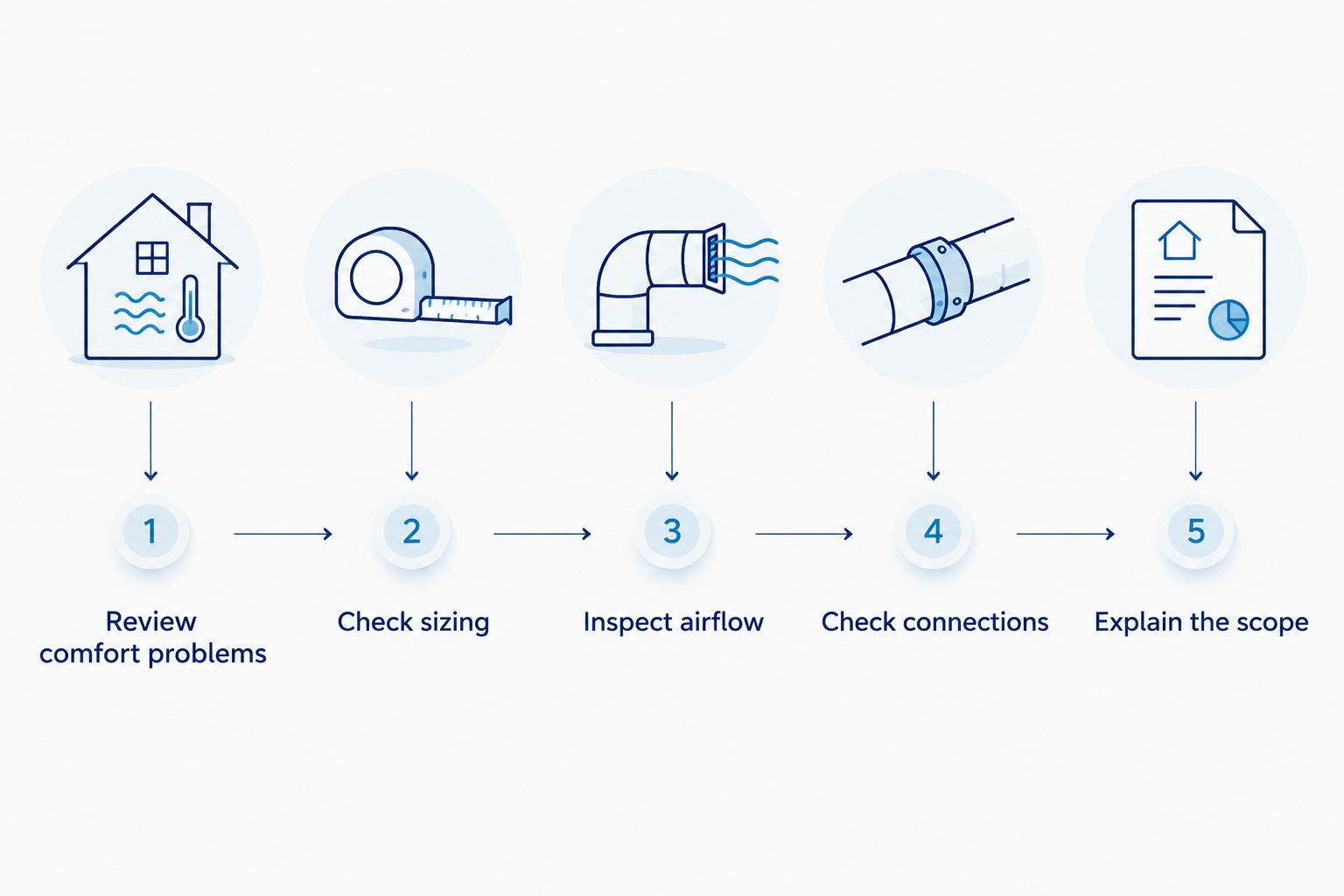
A useful assessment follows the comfort problem through the whole system. These steps help you understand whether a 2026 installation proposal addresses your home rather than simply replaces a piece of equipment.
- Review comfort problems. Describe warm rooms, damp indoor air, unusual noise, and any changes since renovations. Tell the contractor whether the problem affects the whole house or particular spaces.
- Check sizing. Ask how the contractor determined the required cooling capacity. A load calculation estimates the home's cooling needs from its construction and conditions.
- Inspect airflow. The assessment should consider supply ducts, return-air paths, and visible duct condition. Equipment selection and airflow need to work together.
- Check connections. Review electrical requirements, refrigerant piping, drainage, and equipment access. Ask which existing components the contractor intends to retain.
- Explain the scope. Request a written description of included work, exclusions, required approvals, and completion checks. Clarify who handles any work performed by another trade.
The assessment should also make room for your questions. If you don't understand why a component needs replacement, ask for the finding and the practical consequence of leaving it unchanged.
What deserves extra attention near the coast?
Salt air can corrode outdoor equipment near the coast. Ask the contractor to inspect the existing unit's condition and explain how the proposed location affects exposure and future maintenance access.
Outdoor placement also needs enough clearance for airflow and servicing. Putting equipment in a sheltered-looking corner is not useful if the location restricts airflow or makes routine maintenance difficult.
Seasonal homes bring another concern: long periods without someone present to notice drainage or humidity problems. Tell the contractor how you use the home so the discussion includes moisture control and sensible monitoring while you're away.
For a 2026 project, confirm the permitting requirements with the building department responsible for your property. Palm Beach, Martin, and St. Lucie county addresses do not automatically share the same permitting authority or inspection process.
How do you compare installation proposals fairly?
Compare the same work before deciding which proposal fits your home. Two estimates can name similar equipment while including different duct repairs, electrical work, or completion checks.
Place the proposals side by side and identify the equipment, included work, exclusions, and responsibilities. If one contractor includes a return-air change and another does not, ask each to explain the airflow assessment behind that decision.
Avoid assuming that the longest proposal is the strongest. Every added item should have a purpose, and every excluded item should be clear enough that you understand who handles it.
For A.R. Williams Air Conditioning, AC installation discussions include an explanation of the findings and your options, with transparent flat-rate pricing quoted before work starts. That helps you understand the decision, but you should still review the exact scope for your home.
Brand credentials do not replace project details. Ask about the proposed installation, how the system will be checked, and what happens if the completed work does not match the written agreement.
Does higher efficiency solve humidity problems?
Higher efficiency does not, by itself, establish that a system will control humidity well in your home. Equipment sizing, airflow, operating characteristics, and the condition of the home all matter.
An oversized system can cool the air quickly and stop before removing enough moisture. Restricted airflow creates a different problem and also deserves attention before equipment selection.
Ask the contractor how the proposed system addresses the dampness you experience. The answer should refer to your home's conditions, not only to an efficiency rating or a thermostat feature.
For your 2026 installation, describe when humidity feels worst and whether it affects particular rooms. That information gives the technician a more useful starting point than a request for the largest available system.
What should happen before you sign?
You should understand the installation scope before committing. Request clarification while changes can still be written into the agreement.
Check that the paperwork identifies the proposed equipment and explains any duct, electrical, piping, or drainage work. It should also make responsibilities for permits, inspection, cleanup, and old-equipment removal clear.
Ask how changes discovered during installation will be handled. A written process for explaining and approving additional work protects you from making decisions without enough context.
A.R. Williams Air Conditioning is a fit for homeowners who want central AC installation options explained before work starts. Its emphasis on long-term fixes supports that conversation; the right project decision still depends on the assessment and written proposal.
FAQ
Can you estimate central AC installation from my home’s square footage?
Square footage alone is not enough to select a central AC system or define the installation scope. Window exposure, insulation, layout, duct condition, and electrical requirements also affect the proposal.
Do I have to replace my ducts when I replace my AC?
You do not automatically have to replace suitable ducts when you replace your AC. The contractor should inspect their condition and confirm that they can deliver the airflow the proposed system needs.
Will a bigger AC cool my upstairs bedrooms better?
A bigger AC does not automatically fix warm upstairs bedrooms. Restricted ducts, inadequate return airflow, insulation, and room heat gain need evaluation before increasing equipment capacity.
Should permits be included in the installation agreement?
The installation agreement should explain who handles required permits and inspections. Confirm the requirements for your property with the responsible building department.
Can the contractor reuse my existing electrical connections?
Existing electrical connections can remain only when they are suitable for the proposed equipment and meet applicable requirements. Ask the contractor to identify any necessary changes before work begins.
Why does my house feel damp even when the AC cools it?
A cool house can still feel damp when moisture removal does not keep up with indoor conditions. Equipment sizing, airflow, moisture sources, and operating settings deserve evaluation.
What should I ask before accepting an AC replacement proposal?
Ask what findings support the recommendation and exactly what work the proposal includes. Confirm equipment details, exclusions, approval responsibilities, and how the completed system will be checked.
One last thing
Before the crew removes your old system, write down the comfort problems you want the replacement to solve. A warm bedroom, persistent dampness, or noisy return grille gives you a specific issue to discuss during planning and review after installation.
A successful replacement should address those concerns, not simply produce cold air at a nearby vent. Keep the written scope and completion documents together so you have a clear record of what was installed and checked.
If you're considering replacement, talk with a technician at A.R. Williams Air Conditioning about the condition of your current system and the options for your home. Ask for an explanation you understand before choosing the work.
Related guides
- How to tell if your AC needs repair or replacement
- How to read your AC installation contract before signing
- How to prepare your home for AC installation day
