

Whole-home dehumidifier installation cost depends on the equipment selected and the work needed to connect it safely to your home's ductwork, drainage, electrical supply, and controls. Get a written installed quote based on an inspection, rather than treating an equipment-only figure as the project total. Electrical changes, duct repairs, and ongoing maintenance belong in the discussion before you approve the work.
- Whole-home dehumidifier installation cost should cover equipment, duct connections, drainage, electrical work, controls, and startup testing.
- A.R. Williams Air Conditioning explains AC repair options before work starts, a useful first step when humidity accompanies cooling problems.
- Choose dedicated humidity control only after checking AC performance, duct leakage, and moisture sources.
- Compare written installation scopes, not equipment-only figures or promises of energy savings.
If your home feels damp even when the thermostat is satisfied, start with the cause. This guide to reducing indoor humidity without overworking your AC explains why a colder thermostat setting isn't always the right fix.
How much does whole-home dehumidifier installation cost?
The useful number is the complete installed quote for your home, with exclusions written down. For a 2026 installation, ask the contractor to separate the equipment selection from the work needed to make it function correctly. Two proposals aren't equivalent if one includes drainage and controls while the other leaves those items unresolved.
Your quote should explain these parts of the project:
| Installation item | What the written scope should identify | What to clarify |
|---|---|---|
| Equipment | Exact model and moisture-removal capacity | Why that capacity fits your home |
| Duct connections | Where air enters and leaves the unit | Whether existing ducts need changes |
| Drainage | Where collected water goes | Whether gravity drainage or a pump is planned |
| Electrical supply | Required power connection | Whether separate electrical work is excluded |
| Humidity controls | Sensor location and operating arrangement | Whether your existing thermostat is compatible |
| Mounting and access | Installation location and service clearance | Whether filters and drains remain accessible |
| Startup testing | Checks after installation | How airflow, drainage, and controls will be verified |
Ask whether permits or inspections apply to the proposed work and who handles them. Requirements depend on the actual installation and local authority, so a general statement about Florida doesn't settle the question for your address.
Keep the exclusions beside the included work. That makes a proposal easier to understand without a second round of questions.
Why a complete scope matters
A dehumidifier handles moisture, but it doesn't repair a leaking roof, a faulty cooling system, or ducts that pull humid attic air into the house. Buying equipment before identifying those problems risks treating a symptom while leaving the cause in place.
South Florida homes also have different operating patterns. A seasonal home with a higher cooling setpoint has less AC runtime than an occupied home kept cooler. An older house with restricted return airflow needs a different assessment from a newer house with intact, correctly sized ducts.
For 2026 planning, the U.S. Environmental Protection Agency's homeowner mold guidance provides a useful reference: keep indoor relative humidity below 60%, ideally between 30% and 50%. Relative humidity means how much moisture the air holds compared with what it can hold at that temperature. These are general moisture-control guidelines, not a promise that one setting suits every home.
Shared duct connections: check airflow and controls
A whole-home dehumidifier can connect to existing central AC ductwork when the equipment instructions and duct layout support that arrangement. The installer must decide where to take in humid air and where to return treated air.
The benefit is whole-home distribution through an existing air pathway. The limitation is dependence on that pathway: restricted returns, leaking ducts, or an unsuitable connection layout can interfere with performance.
Ask whether the AC blower must run during dehumidification and how the controls coordinate both systems. Don't accept a connection plan based only on where the installer finds open space. The manufacturer's instructions should guide the arrangement.
For a closer look at the connection questions, read how a whole-home dehumidifier connects to ductwork.
Dedicated duct connections: check routing and access
A dedicated duct arrangement gives the dehumidifier its own air connections rather than relying entirely on the central AC duct layout. It requires a suitable route through the home and a plan for distributing treated air.
This approach offers more flexibility when existing duct connections aren't suitable. Its drawback is additional installation work, including space for ducts and potential openings in ceilings or walls. Ask who completes any finish repairs.
Neither arrangement wins automatically. The right choice depends on the equipment instructions, the house layout, and measured airflow.
| Arrangement | Best for | Main benefit | Main limitation |
|---|---|---|---|
| Shared duct connections | Homes with suitable existing central ductwork | Uses an established distribution path | Requires compatible airflow and coordinated controls |
| Dedicated duct connections | Homes where existing connections aren't suitable | Allows a separate air-routing plan | Requires additional routing space and installation work |
Why whole-home dehumidifier installation cost varies
The equipment model is only part of the project. These installation factors explain why the scope changes from one single-family home to another:
- Moisture load: Equipment selection should account for moisture entering the house and generated indoors, not square footage alone.
- Duct condition: Leaks, restricted returns, and unsuitable connection points affect the work required before installation.
- Installation access: Attic openings, working space, and service clearance influence placement and the installation method.
- Drain route: A nearby suitable drain is a different scope from a route that needs a condensate pump or additional protection.
- Electrical requirements: The selected unit's instructions determine the required power arrangement and whether changes are necessary.
- Controls and testing: Compatibility, sensor placement, and coordination with the AC must be resolved before the job is complete.
Coastal exposure deserves attention during the AC assessment, too. Salt air can corrode outdoor coils. A cooling problem associated with that damage needs its own diagnosis; adding indoor humidity equipment doesn't repair the outdoor unit.
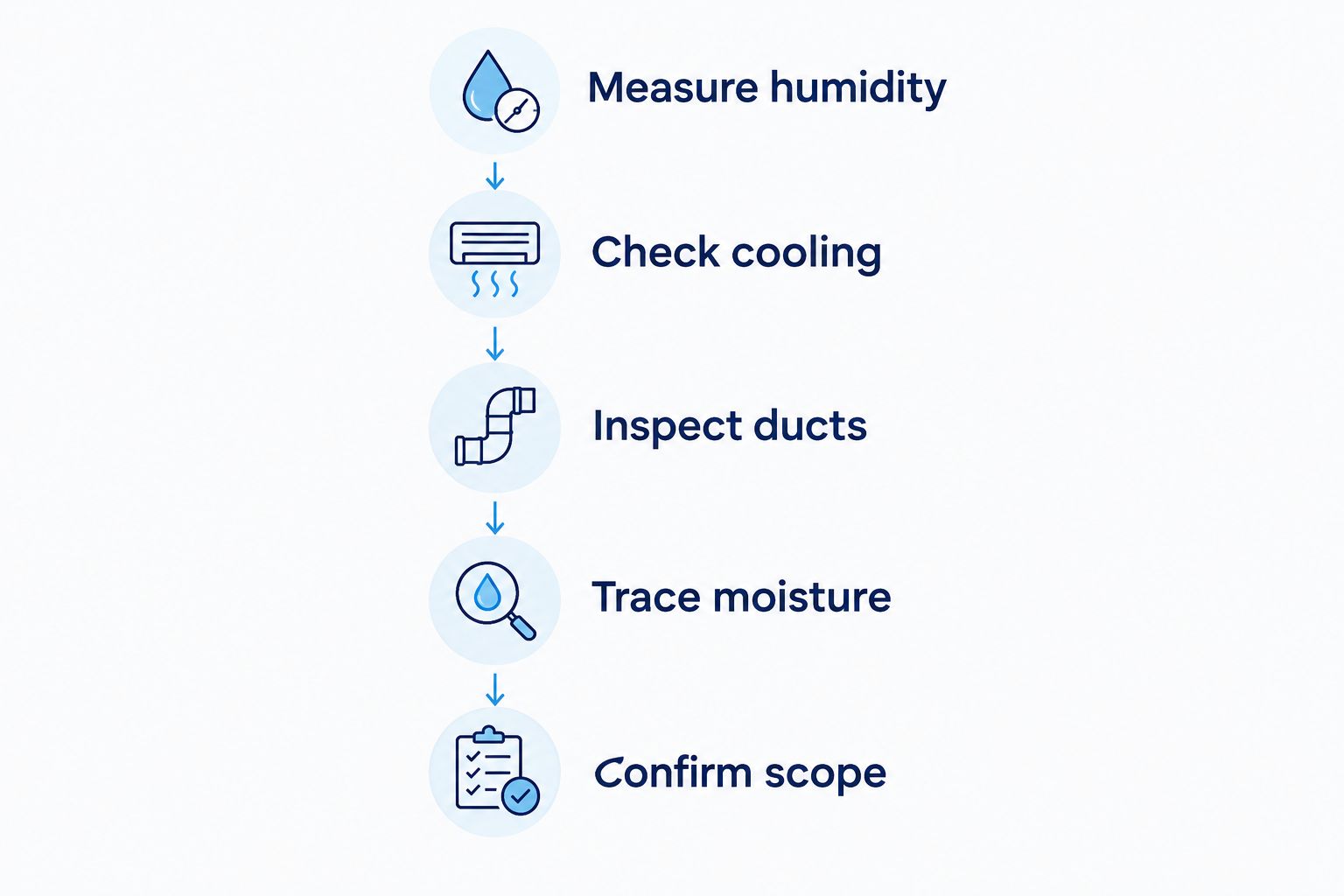
What should happen before you approve installation?
A good assessment connects the dampness you notice with measurements and system checks. You don't need to diagnose the equipment yourself. You need an explanation that makes the proposed work understandable.
1. Measure humidity
Use a humidity meter to record conditions in occupied rooms alongside the thermostat setting. Note whether the damp feeling occurs throughout the home or only in a particular room.
A reading taken just after a shower tells a different story from a bedroom that stays damp during normal use. Keep the meter away from supply vents and direct moisture sources so the reading reflects the room rather than a small pocket of air.
2. Check cooling
Have a technician assess whether the AC is cooling and moving air correctly. Short cycling, restricted airflow, and equipment faults need investigation before a dehumidifier becomes the default recommendation.
A.R. Williams Air Conditioning provides AC repair and maintenance for homeowners and explains the findings before presenting options. That is relevant when poor humidity control comes with weak cooling or unusual system behavior.
3. Inspect ducts
Ask about return-air restrictions and duct leakage, especially where ducts pass through an attic. A leak on the return side can pull humid air into the system.
The assessment should also identify usable connection points. A drawing or clear explanation of the proposed air route helps you understand what will change.
4. Trace moisture
Look beyond the HVAC equipment. Plumbing leaks, roof leaks, bathroom ventilation, and outdoor air entering through gaps all deserve attention when the symptoms point in those directions.
A musty smell doesn't prove that a dehumidifier is the solution. Visible water damage needs investigation rather than a lower humidity setting alone.
5. Confirm scope
For your 2026 proposal, ask the contractor to explain why the recommended equipment and connection arrangement fit the findings. Get the drainage route, power requirements, controls, and exclusions in writing.
Approve the installation plan only when you understand both the problem it addresses and the work it includes. You don't need a technical lecture, but you should be able to explain the recommendation back in everyday language.
Does a whole-home dehumidifier replace your AC?
A whole-home dehumidifier doesn't replace central air conditioning. It removes moisture, while the AC handles cooling and also removes moisture during operation. A dehumidifier adds heat as it operates, so the installation assessment should consider its interaction with the cooling system.
Dedicated humidity control is relevant when the home reaches its temperature setting but still has excess moisture. It isn't a substitute for repairing an AC that fails to cool properly.
Be cautious about claims that the equipment will automatically reduce your electric bill. It uses electricity, and any change in total household energy use depends on operation, settings, and the existing system. Treat comfort and moisture control as the reason for evaluation, not an assumed savings result.
What humidity setting should you use?
Below 60% relative humidity is the EPA's general moisture-control guidance, with 30% to 50% described as ideal. Have the installer recommend a setting appropriate to your home and explain where the control measures humidity.
For a 2026 installation, ask how you'll confirm that the system reaches its target in occupied rooms. A hallway sensor doesn't establish that every closed bedroom has the same conditions.
Don't confuse a target setting with a result. Persistent condensation, visible dampness, or musty odors require follow-up even when the display looks acceptable.
What should you compare between installation proposals?
Compare the same equipment and the same completed work. A proposal is easier to evaluate when it identifies the model, connection arrangement, drainage, electrical responsibilities, and testing rather than describing everything as a standard installation.
Ask how you'll access the filter and what routine maintenance the manufacturer requires. Confirm who handles a drainage problem or control issue after installation, and request the applicable warranty terms in writing. Don't assume equipment coverage and installation workmanship coverage are identical.
If one proposal includes duct repairs and another doesn't, ask why. Different findings need explanation before you make a decision.
Choosing help without pressure
A.R. Williams Air Conditioning is a fit for homeowners who want AC repair options explained before work begins. Its stated approach includes transparent flat-rate pricing quoted before work starts and long-term fixes rather than shortcuts.
That approach helps when you're deciding whether the cooling system needs attention before adding humidity equipment. The limitation is straightforward: an AC assessment alone doesn't establish the equipment or installation scope your home needs. The recommendation still has to match the findings.
You can request an estimate for whole-home dehumidifier installation and ask for the proposed scope in writing. Bring your humidity observations and describe when the home feels damp.
FAQ
Can I get an accurate installation estimate without a home inspection?
An accurate installed estimate needs information about your home’s ducts, drainage, electrical supply, and equipment access. A preliminary estimate should clearly identify assumptions and items that still need inspection.
Why is my house humid when the AC is cooling?
Your house can remain humid when the AC satisfies the temperature setting before removing enough moisture. Duct leakage, moisture sources, and cooling-system problems also need checking before you choose additional equipment.
Will a whole-home dehumidifier cool my house?
A whole-home dehumidifier removes moisture but doesn’t replace your AC’s cooling function. It adds heat during operation, so its effect on the cooling system belongs in the installation assessment.
Does a whole-home dehumidifier need a drain?
A whole-home dehumidifier needs a way to remove the water it collects. The installation plan should identify a suitable gravity drain or condensate pump and explain the required maintenance.
Should I replace my AC instead of adding a dehumidifier?
Replace or repair the AC when its condition or performance justifies that work, not solely because the house feels damp. Evaluate humidity readings, cooling performance, duct condition, and moisture sources before choosing either project.
Can a dehumidifier fix a musty smell?
A dehumidifier addresses excess humidity, but it doesn’t repair leaks or remove existing moisture-damaged materials. Investigate the source of a persistent musty smell before treating humidity as the only problem.
What maintenance does a whole-home dehumidifier need?
A whole-home dehumidifier needs the filter, drainage system, and other service items maintained according to its manufacturer. Ask for accessible placement and written maintenance instructions before installation.
One last thing
Ask for a demonstration of the humidity control before the installer leaves. You should know where it measures moisture, how to adjust it, and how to recognize a drainage or operating problem.
For your 2026 project, keep the written scope and startup information with your equipment documents. If A.R. Williams Air Conditioning evaluates your AC, ask the technician to connect the findings to your humidity concerns. A clear diagnosis is more useful than an equipment recommendation without an explanation.
Related guides
- How to tell whether you need a dehumidifier or a new AC
- How to read your AC installation contract before signing
