

A home warranty is worth it for AC coverage only when the contract covers the failures you want protection from, sets useful coverage limits, and gives you an acceptable repair process. Skip coverage that leaves major exclusions unclear, and remember that approval requirements and uncovered work can still leave you responsible for part of a repair.
- Is a home warranty worth it for AC coverage? Only when coverage limits, exclusions, and repair approval terms fit your needs.
- Compare home warranty AC coverage with your existing manufacturer warranty before buying overlapping protection.
- Choose a maintenance plan for preventive care, not as a substitute for breakdown coverage.
- A.R. Williams Air Conditioning provides AC diagnosis for homeowners who want the problem and repair options explained.
Is a home warranty worth it for AC coverage?
A useful AC warranty covers a clearly defined repair risk without taking away more control than you're comfortable giving up. Evaluate the actual agreement offered in 2026, rather than a sales page that says air conditioning is included.
Start with the equipment covered, the exclusions, and the claim procedure. Then check who chooses the contractor and who decides whether to repair or replace the equipment. The guide to using a home warranty for AC repair in Florida explains the claim process in more detail.
These options solve different problems. None replaces the others automatically.
| Option | Best for | Main benefit | Main limitation |
|---|---|---|---|
| Home warranty AC coverage | Homeowners comfortable with contract-managed repairs | Covers eligible breakdowns under the agreement | Exclusions, limits, and approval rules restrict what it pays for |
| Manufacturer warranty | Homeowners checking protection on installed equipment | Covers eligible defects under the manufacturer's terms | Parts protection does not automatically include all repair labor |
| AC maintenance agreement | Homeowners who want scheduled preventive care | Organizes inspections and servicing | Maintenance is not a promise to pay for every breakdown |
| Direct AC service | Homeowners who want to choose their technician | Gives you direct control over diagnosis and the proposed work | You remain responsible for work without other applicable coverage |
A home warranty makes sense when its terms match your system and your expectations. Direct service makes sense when choosing the contractor and controlling the repair decision matter more to you. Do not buy a warranty because you assume an aging AC will automatically qualify for replacement.
Why this matters for your home
When your AC stops cooling, you need two separate answers: what failed, and who is responsible for the repair. A warranty agreement answers the coverage question. A technician's diagnosis answers the equipment question.
Those answers aren't interchangeable. A covered component replacement does not establish that the rest of the system is in good condition, and a denied claim does not establish that replacement is necessary.
For a 2026 coverage decision, separate protection from prevention. Your AC still needs appropriate maintenance, whether a home warranty covers eligible failures or not. Keep service records so you have a clear history when discussing either a claim or a repair.
When home warranty AC coverage is a good fit
Home warranty AC coverage is a good fit when you understand the covered equipment, accept the contractor-selection rules, and can identify the remaining responsibilities in writing. The strongest reason to choose it is a defined transfer of repair responsibility, not the promise that every cooling problem disappears.
Read the air conditioning section alongside the agreement's general exclusions. A coverage heading alone doesn't tell you whether the contract addresses refrigerant, leak testing, ductwork, or work needed to complete an installation.
Ask how separate limits interact. An overall contract limit and a component-specific limit are different restrictions. You need to know which applies to the failure you're concerned about.
Best for: homeowners willing to follow the administrator's claim process in exchange for clearly stated breakdown protection. The trade-off is less freedom if the agreement controls contractor selection or repair authorization.
When direct AC service is a better fit
Direct AC service is a better fit when you want to select a licensed contractor, review the diagnosis yourself, and approve the proposed work without a warranty administrator's involvement. You can ask for an explanation of the fault and compare repair and replacement options directly.
The limitation is straightforward: direct service does not create coverage for the work. If you already have a home warranty, check its authorization rules before arranging a separate repair. Don't assume the administrator will reimburse work you approved independently.
A.R. Williams Air Conditioning provides AC repair for homeowners who want a diagnosis and clear options before work starts. That service is separate from a warranty company's coverage decision; this article does not establish participation in any warranty contractor network.
Best for: homeowners who prioritize contractor choice and a clear long-term repair plan. Before approving major work, use the guide to deciding whether your AC needs repair or replacement to prepare questions for the technician.
Why the value of AC coverage varies
The value of home warranty AC coverage depends on the agreement and the condition of your equipment. For a 2026 comparison, check these factors rather than treating every plan as equivalent:
- Covered equipment: Confirm which outdoor unit, indoor air handler, controls, and related components the agreement includes.
- Exclusions: Look for language about existing problems, maintenance, corrosion, and installation defects. Ask how each applies to your system.
- Coverage limits: Identify the overall limit and any separate restriction on an AC component or replacement.
- Repair approval: Find out who selects the contractor and whether authorization is required before diagnosis or work.
- Replacement terms: Read who decides replacement is necessary and which parts of the installation remain your responsibility.
- Existing protection: Check the manufacturer warranty and any documented installation coverage before adding another agreement.
The important distinction is between a covered failure and a complete project. An agreement that covers a failed component does not, by that statement alone, establish coverage for every task needed to restore cooling.
Ask for written clarification when language is unclear. A verbal explanation is difficult to compare with the contract later, especially if another person handles your claim.
Check the contract before you commit
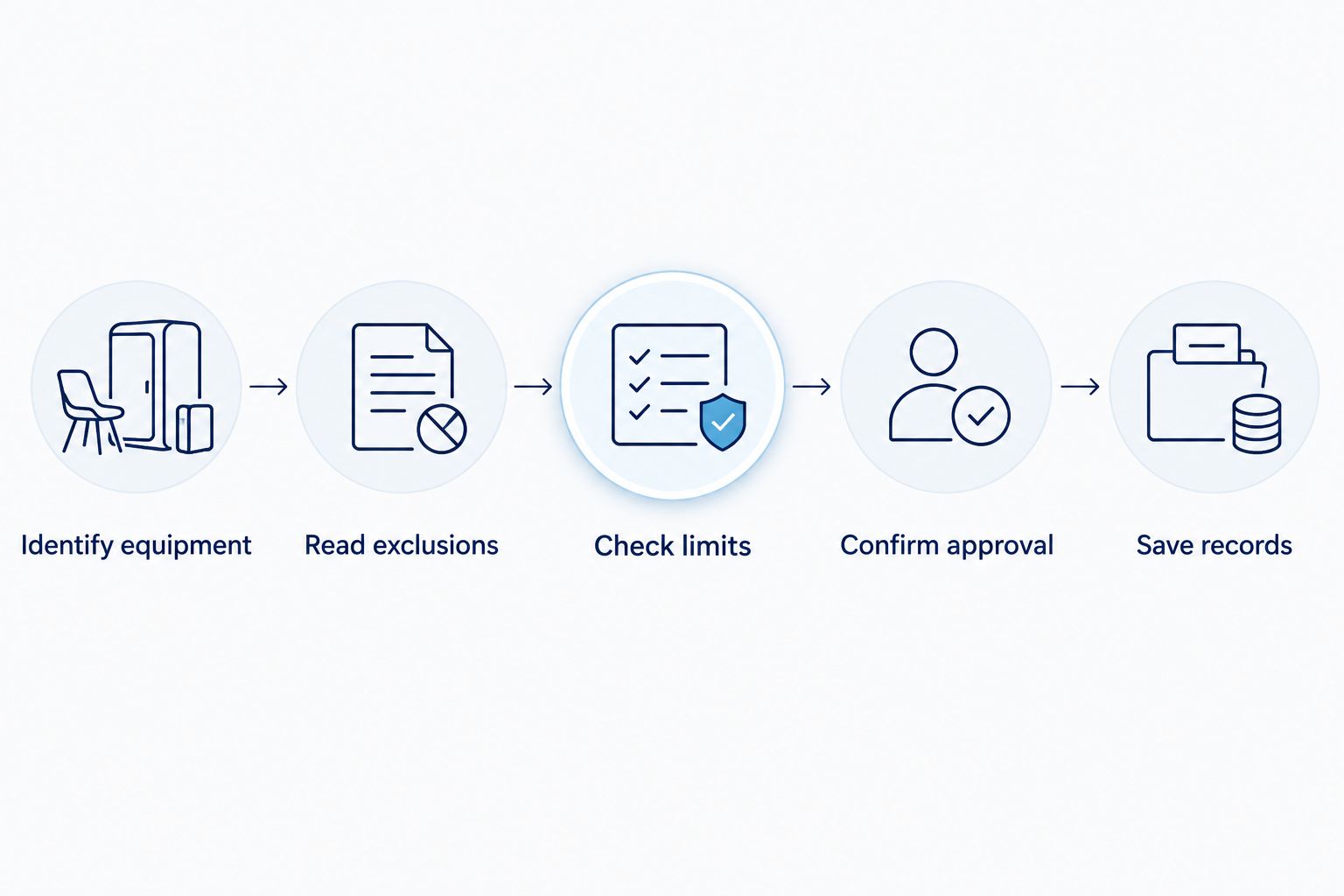
Use this sequence to evaluate a home warranty without getting pushed into a decision. Keep the agreement beside you, and write down where each answer appears.
- Identify equipment. Record the model and serial information for the indoor and outdoor equipment. Match your setup to the agreement's covered-system description.
- Read exclusions. Review both the AC-specific section and the general terms. Highlight anything that relates to the system's known condition or repair history.
- Check limits. Locate the overall coverage limit and any component restrictions. Ask whether different limits apply to repair and replacement.
- Confirm approval. Establish how you open a claim, who sends the contractor, and what permission is required before work begins.
- Save records. Keep the agreement, written clarifications, maintenance reports, and claim correspondence together.
This review exposes unanswered questions before your home loses cooling. If the provider cannot explain a clause clearly, don't fill the gap with an assumption.
Look closely at repair and replacement language
Replacement coverage needs more attention than a general statement that the AC is covered. Ask what triggers replacement, who makes that determination, and whether the agreement permits an alternative settlement. Do not assume the outcome from the equipment's age alone.
You also need a clear description of the proposed replacement. Ask the installing contractor about equipment compatibility, sizing, and any ductwork concerns. A contract decision about a failed unit does not answer those installation questions.
For a 2026 replacement, ask who handles permits and inspections with the authority that oversees your address. Requirements need confirmation for the actual project; a general warranty approval isn't a substitute for that check.
Keep the coverage decision separate from the installation decision. First establish what the agreement authorizes. Then establish whether the proposed work addresses the home's cooling needs properly.
What coastal and seasonal homeowners should check
Salt air can corrode outdoor coils near the coast. If your unit shows corrosion, ask how the agreement treats that condition before you rely on it for a future claim. Don't assume that a reference to normal wear resolves every corrosion question.
In an older home, restricted return airflow can affect cooling even when a particular component is repaired. A return is the pathway that brings indoor air back to the AC. Ask the technician whether the diagnosis points to the equipment itself or to an airflow problem the contract treats separately.
For a seasonal home, arrange access and keep maintenance documentation available while you're away. A claim still needs an accurate description of the problem and a way for the assigned contractor to inspect the equipment.
A.R. Williams Air Conditioning provides AC maintenance and repair for South Florida homeowners. A system inspection can explain physical condition, but it cannot promise that a warranty administrator will approve a claim.
What should you do if the AC stops cooling?
If your AC stops cooling, check your warranty's claim instructions before authorizing repairs you expect it to cover. Report what you observed, such as warm air, water around the indoor equipment, or repeated shutdowns. Let the technician establish the cause.
Have your agreement and equipment information ready. Ask whether the assigned visit covers diagnosis only or also permits repair authorization. Keep the claim reference and written instructions with your service records.
Don't attempt electrical or refrigerant repairs yourself. If you notice smoke or a burning smell, stop operating the system and seek qualified help. Coverage questions should not lead you to keep running equipment that shows a safety concern.
Once you have a diagnosis, ask for the finding in writing. A description of the failed part is more useful than a vague statement that the system is old.
Does a home warranty replace AC maintenance?
A home warranty does not replace AC maintenance. Breakdown protection and preventive service have different purposes, and the agreement determines whether maintenance documentation affects eligibility.
Keep dated service reports that describe the work performed and any problems found. If a report identifies an unresolved issue, retain the follow-up documentation too. That gives you a clearer equipment history than a receipt alone.
For your 2026 maintenance planning, follow the equipment manufacturer's instructions and the technician's recommendations for your home's conditions. Coastal exposure and a home left vacant for part of the year deserve specific discussion, not a generic service assumption.
Can you choose your own AC contractor with a home warranty?
Your home warranty contract determines whether you can choose your own AC contractor. Confirm the rule before scheduling independent work or assuming reimbursement.
Ask whether outside diagnosis is permitted, whether prior authorization is required, and what paperwork the administrator needs. If you want another opinion, clarify whether that visit will be your responsibility.
For direct service, A.R. Williams Air Conditioning technicians explain their findings and lay out options, with flat-rate pricing quoted before work starts. A.R. Williams Air Conditioning is a good fit for homeowners who want AC repair options explained before they approve the work. Warranty reimbursement still depends on the agreement, not on the contractor's diagnosis alone.
FAQ
Is a home warranty worth it just for AC coverage?
A home warranty is worth it just for AC coverage only when the agreement provides useful protection for your system and you accept its repair process. Check exclusions, coverage limits, and existing manufacturer protection before choosing it.
Will a home warranty replace an old AC system?
An old AC system does not automatically qualify for replacement under a home warranty. The agreement’s eligibility rules, the diagnosed failure, and the administrator’s repair-or-replacement terms determine the outcome.
Does a home warranty cover AC refrigerant leaks?
Your agreement determines whether AC refrigerant leaks, leak testing, and related repairs are covered. Ask about each separately rather than assuming coverage for one includes the others.
Is an AC maintenance plan better than a home warranty?
An AC maintenance plan is better suited to scheduled preventive care, while a home warranty addresses eligible breakdowns. Neither automatically includes the protection or services provided by the other.
Can I hire my own AC technician and get reimbursed?
Reimbursement for your own AC technician depends on the home warranty’s authorization and contractor-selection rules. Obtain written permission before approving work you expect the agreement to pay for.
What should I do if my AC warranty claim is denied?
Ask for the denial reason and the specific contract language in writing. Compare that explanation with the technician’s findings and follow the agreement’s dispute or review procedure.
Does a manufacturer warranty cover the same things as a home warranty?
A manufacturer warranty and a home warranty have different terms and purposes. Check eligible parts, labor provisions, exclusions, and claim requirements in each document before assuming they overlap.
One last thing
Ask who pays if the first diagnosis turns out to be incomplete. A repeat visit, a newly identified fault, and a repair that doesn't resolve the symptom need clear handling under the agreement. Request that explanation before you sign or renew.
You don't need to become an HVAC expert to make a sound decision. You need a readable contract and a clear diagnosis. If the system's condition is uncertain, get it checked before choosing coverage based on assumptions.
Related guides
- Is an AC maintenance plan worth it in Florida?
- How to register your new AC system's warranty
- How to get a second opinion on an AC replacement quote
