

Yes, upgrading to a SEER2-rated AC system is worth considering when your current system needs replacement, struggles to keep you comfortable, or has documented efficiency problems. A higher rating alone does not justify replacing a reliable system, and it does not guarantee better humidity control. In 2026, the right decision starts with your home's cooling needs, the condition of your equipment, and the quality of the proposed installation.
- Is it worth upgrading to a SEER2 AC system? Yes, when replacement solves documented cooling or reliability problems.
- SEER2 compares rated efficiency, not installation quality or guaranteed energy savings.
- Central AC sizing and humidity control matter as much as the efficiency rating.
- A.R. Williams Air Conditioning offers residential AC replacement with technicians who explain your options.
Is it worth upgrading to a SEER2 AC system?
Upgrade when the replacement addresses a verified problem. Keep a reliable system when the only reason to replace it is a higher efficiency label. That distinction protects you from buying equipment before anyone has explained what your home actually needs.
SEER2 is a seasonal cooling-efficiency rating measured under standardized testing conditions. Higher ratings indicate greater rated efficiency, but your household's results also depend on weather, thermostat settings, ductwork, equipment sizing, and installation.
Use this comparison to separate the replacement decision from the equipment decision:
| Option | Best for | Main benefit | Main limitation |
|---|---|---|---|
| Keep and maintain the existing AC | Homeowners with reliable cooling and no diagnosed major defect | Preserves equipment that still meets your needs | Does not change the system's original efficiency or operating design |
| Replace with a properly sized single-stage central AC | Homeowners whose cooling needs suit straightforward on-or-off operation | Simpler operation with a current efficiency rating | Less flexibility to match changing cooling demand |
| Replace with a two-stage central AC | Homeowners who need lower-output operation during lighter cooling demand | Offers separate lower and higher cooling stages | Requires compatible equipment and correct setup |
| Replace with a variable-speed central AC | Homeowners seeking closer temperature control and humidity management | Adjusts output across a wider operating range | More involved controls and service requirements |
None of these choices fixes poor ductwork by itself. For a home that feels cool but clammy, start with AC systems for high-humidity climates rather than choosing from an efficiency ranking alone.
Why this matters in a humid climate
An AC system must remove heat and moisture. A replacement that cools rooms quickly but shuts off before removing enough moisture can leave you dissatisfied despite its efficiency rating.
The U.S. Environmental Protection Agency's indoor mold guidance recommends keeping relative humidity below 60%, ideally between 30% and 50%. Those are indoor moisture-management guidelines, not a promise that a particular AC will maintain them under every condition.
For your 2026 replacement decision, measure how the house feels and performs. Note whether bedrooms stay warm, whether the system cycles repeatedly, and whether indoor humidity remains elevated after the temperature reaches your setting.
Coastal conditions matter, too. Salt air can corrode outdoor coils, while older homes can have undersized return-air paths. Both deserve inspection before a contractor recommends new equipment.
What SEER2 tells you, and what it leaves out
The U.S. Department of Energy's SEER2 testing procedure uses revised conditions, including higher external static pressure for applicable ducted equipment. Static pressure is the resistance the blower works against as it pushes air through the system.
That makes SEER2 a different testing measure from the older SEER rating. Do not compare an old SEER number directly with a new SEER2 number and treat the difference as your expected savings.
SEER2 also does not tell you how much moisture the system will remove in your home. It does not establish whether the installer selected the correct capacity, sealed the ducts, or configured the blower correctly.
For a 2026 equipment comparison, ask for the certified efficiency of the complete matched system. The outdoor unit, indoor equipment, and applicable components must be evaluated together. A brochure rating for an equipment family is not enough to establish the rating of your proposed installation.
When keeping your current AC makes sense
Keeping your existing AC is reasonable when it cools consistently, manages moisture acceptably, and has no diagnosed defect that supports replacement. Maintenance remains necessary. A new efficiency standard does not turn functioning equipment into failed equipment.
Ask the technician to distinguish a repairable problem from a broader equipment problem. A restricted filter, dirty coil, or airflow issue needs a diagnosis, not an automatic replacement recommendation.
The limitation is straightforward: maintenance cannot redesign the equipment. If your existing system cannot meet the home's needs even after documented problems are corrected, continuing to maintain it does not resolve that mismatch.
Choose continued maintenance when the equipment's condition and measured performance support it. Ask what was checked and what findings would change that recommendation.
When a replacement is the stronger choice
Replacement deserves closer consideration when major equipment deterioration, repeated faults, or a confirmed capacity mismatch prevents dependable comfort. The recommendation should explain the problem and how the proposed system addresses it.
A replacement also creates an opportunity to correct installation problems. That can include inadequate return airflow, leaking ducts, or controls that do not suit the equipment. Those items belong in the proposed scope, not in a vague promise that a new AC will work better.
Ask for a cooling-load calculation, an assessment of how much cooling your particular house needs. The calculation should account for the building, rather than simply repeat the capacity printed on the old unit.
The guide to choosing the right AC size for your home explains why capacity deserves its own review. Bigger equipment is not a substitute for a properly designed system.
Single-stage central AC: best for straightforward operation
A single-stage central AC runs its compressor at one cooling output when it is on. Correctly sized equipment can meet a home's cooling needs without a more elaborate compressor design.
Its advantage is simpler operation. Its limitation is that it cannot reduce compressor output to closely match lighter cooling demand.
Ask how the proposed system will manage humidity when outdoor temperatures are milder but the air remains damp. The answer should address sizing, airflow, and controls, not just quote the SEER2 rating.
Two-stage central AC: best for changing cooling demand
A two-stage central AC provides lower and higher cooling output. Lower-stage operation can support longer cooling cycles when the house does not need full output.
That operating flexibility can help with comfort and moisture removal when the equipment is selected and configured correctly. It is not a guarantee of a particular indoor humidity level.
The trade-off is added equipment and control complexity compared with single-stage operation. Confirm that the proposed thermostat and indoor equipment support both stages as intended.
Variable-speed central AC: best for closer comfort control
A variable-speed central AC adjusts compressor output across a range instead of relying only on full-output operation. That allows the system to respond more closely to changing cooling needs.
Longer, lower-output operation can support moisture removal. However, the equipment still needs appropriate airflow, compatible controls, and a correctly designed installation.
Its limitation is more involved setup and servicing. Choose variable-speed equipment for an identified comfort need, not because it automatically carries the highest efficiency rating in the proposal.
Why the value of a SEER2 upgrade varies
The same equipment can produce different results in different homes. These factors explain why a rating cannot answer the entire replacement question:
- Current condition: Replacing deteriorated equipment solves a different problem from replacing equipment that still works properly.
- Cooling demand: A frequently occupied home and a seasonal residence have different operating patterns.
- Airflow: Restricted returns and leaking ducts can prevent new equipment from delivering the intended comfort.
- Humidity needs: A damp house requires attention to moisture removal, not just room temperature.
- Coastal exposure: Salt-related corrosion affects the outdoor equipment's condition and maintenance needs.
- Installation scope: Sizing, matched components, controls, and startup checks affect how the completed system performs.
For a snowbird home, include the months when the property sits empty. Ask how the system and controls will manage indoor conditions during those periods. A replacement recommendation should reflect how you actually use the house.
How to evaluate a replacement proposal without pressure
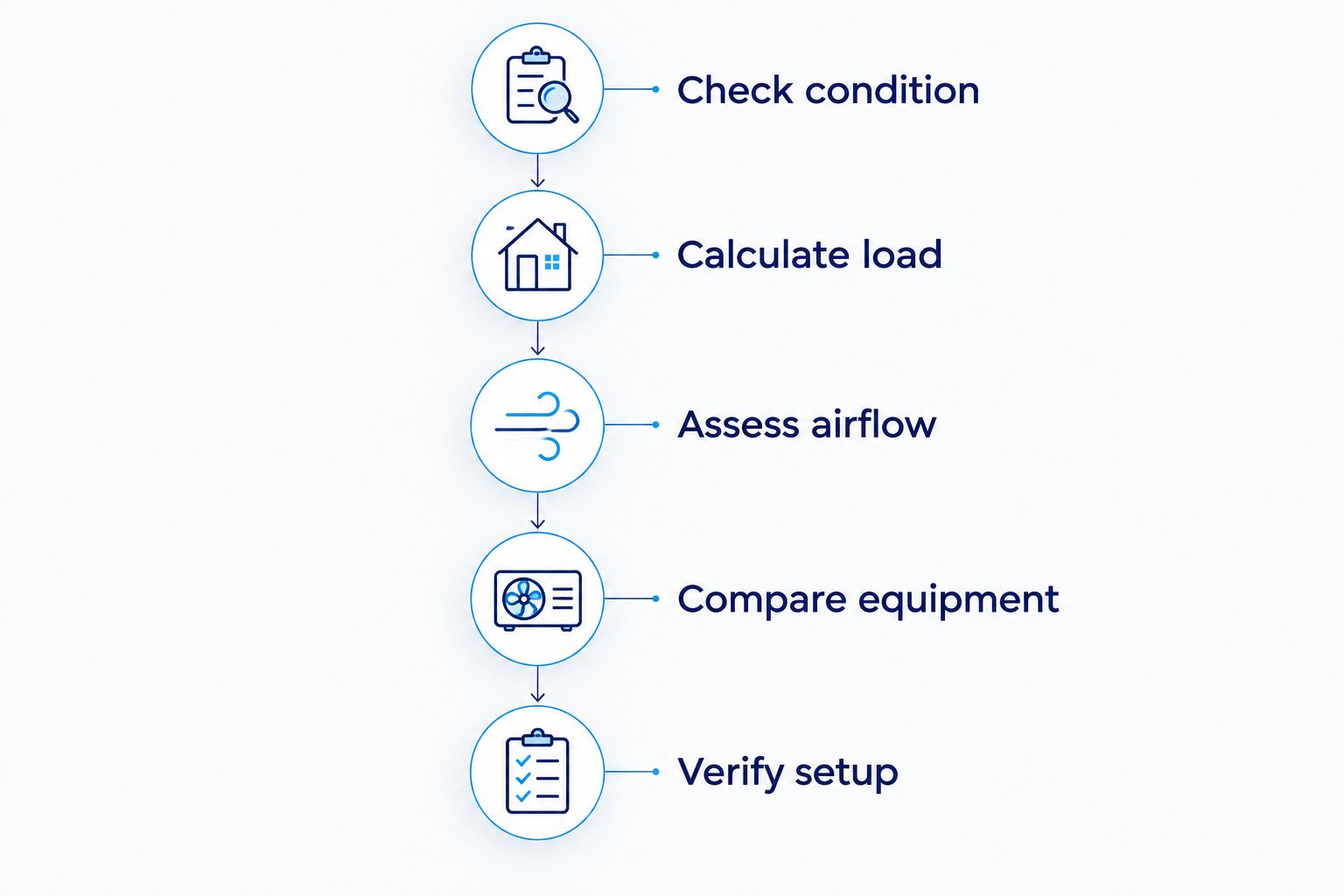
A clear proposal lets you understand the decision before agreeing to it. In 2026, ask the contractor to walk through the following sequence and put the important findings in writing.
- Check condition. Identify the existing equipment and document the fault, deterioration, or comfort problem behind the recommendation.
- Calculate load. Establish the home's cooling needs instead of selecting capacity from floor area alone.
- Assess airflow. Review return-air paths, duct condition, and the resistance the blower must overcome.
- Compare equipment. Identify the proposed matched system, its SEER2 rating, and how its operating design addresses your needs.
- Verify setup. Explain the startup checks, control settings, and inspection responsibilities included in the work.
Each step answers a different question. Skipping the airflow assessment, for example, leaves you without an explanation of whether the existing ducts can support the proposed equipment.
Permit and inspection requirements depend on the authority responsible for your property. Ask who handles those steps and whether they are included in the written scope. Do not assume a process discussed for a neighboring county applies to your address.
Will a higher SEER2 rating lower my electric bill?
A higher SEER2 rating indicates greater seasonal efficiency under standardized testing conditions. It does not establish a guaranteed reduction in your household electricity use.
Request an estimate based on your actual cooling use, local electricity rate, and the proposed matched equipment. Ask the contractor to identify the assumptions. Whole-house bills also include appliances, water heating, and other loads, so they do not isolate AC consumption.
Does a higher SEER2 rating mean better humidity control?
A higher SEER2 rating does not establish better humidity control. Compressor operation, sizing, airflow, controls, and moisture entering the house all affect the result.
Use the EPA's 30% to 50% ideal indoor relative-humidity guidance as context for the conversation. Ask how the proposed system addresses your measured humidity problem rather than accepting the efficiency rating as the answer.
Do I have to replace a working AC because it uses SEER?
You do not have to replace a working AC merely because its label uses the older SEER measure. Efficiency requirements for new equipment do not, by themselves, establish a reason to remove your existing system.
Base the decision on condition and performance. A technician should explain any separate equipment or refrigerant issue that affects your options.
What a helpful replacement conversation looks like
A.R. Williams Air Conditioning is best for South Florida homeowners seeking residential AC replacement with clearly explained options. Its technicians explain their findings, and the company quotes flat-rate pricing before work starts.
A.R. Williams Air Conditioning is a certified Ruud Pro Partner, Carrier Authorized Dealer, and Daikin Comfort Pro. Those credentials do not replace a home-specific assessment. The limitation remains that no dealer designation or equipment rating can establish your expected savings without examining the installation and operating conditions.
Ask which problem each recommendation solves. If you are comparing options, request the same installation scope for each so differences in ductwork, controls, or included work do not get hidden behind equipment names.
Discuss your AC replacement options
Ask a technician to explain your system’s condition and the reasons for a proposed upgrade.
FAQ
Is it worth upgrading to a SEER2 AC system if my current AC works?
A SEER2 upgrade is not automatically worthwhile when your current AC works reliably and keeps your home comfortable. Have its condition and performance assessed before replacing it solely for a higher rating.
Can I compare SEER and SEER2 ratings directly?
SEER and SEER2 ratings are not directly interchangeable because they use different testing conditions. Compare proposed replacement systems using certified ratings under the same testing measure.
Will a high-SEER2 AC fix my upstairs bedrooms being warm?
A high-SEER2 AC does not automatically fix warm upstairs bedrooms. The contractor needs to assess cooling load, duct delivery, return airflow, and other causes of uneven temperatures.
Is variable-speed AC always better than single-stage AC?
Variable-speed AC provides more flexible output, but it is not automatically the right choice for every home. Choose it when its operating features address documented comfort or humidity needs.
Does a higher SEER2 rating mean I need a bigger AC?
A higher SEER2 rating does not mean you need a bigger AC. Efficiency and cooling capacity are separate measures, and capacity should follow a home-specific cooling-load calculation.
Can I replace just the outdoor AC unit to improve efficiency?
Replacing only the outdoor unit requires a compatibility assessment of the complete system. Ask for the certified matched combination and its rating rather than assuming the outdoor unit’s advertised efficiency applies.
What should I ask before agreeing to an AC upgrade?
Ask what problem the replacement solves, how the capacity was selected, and what installation work is included. Request the proposed matched-system rating and an explanation of startup checks.
One last thing
For your 2026 decision, ask this question: "If the efficiency ratings were the same, which system would you recommend for my home, and why?" It separates useful comfort features from the label and gives the technician room to explain the installation.
A.R. Williams Air Conditioning can walk you through residential AC replacement options. Start with the condition of your system and what you want the replacement to improve.
Related guides
- How to choose the right SEER2 rating for your Florida home
- How to tell if your AC needs repair or replacement
- Is a variable-speed AC system worth the cost?
