
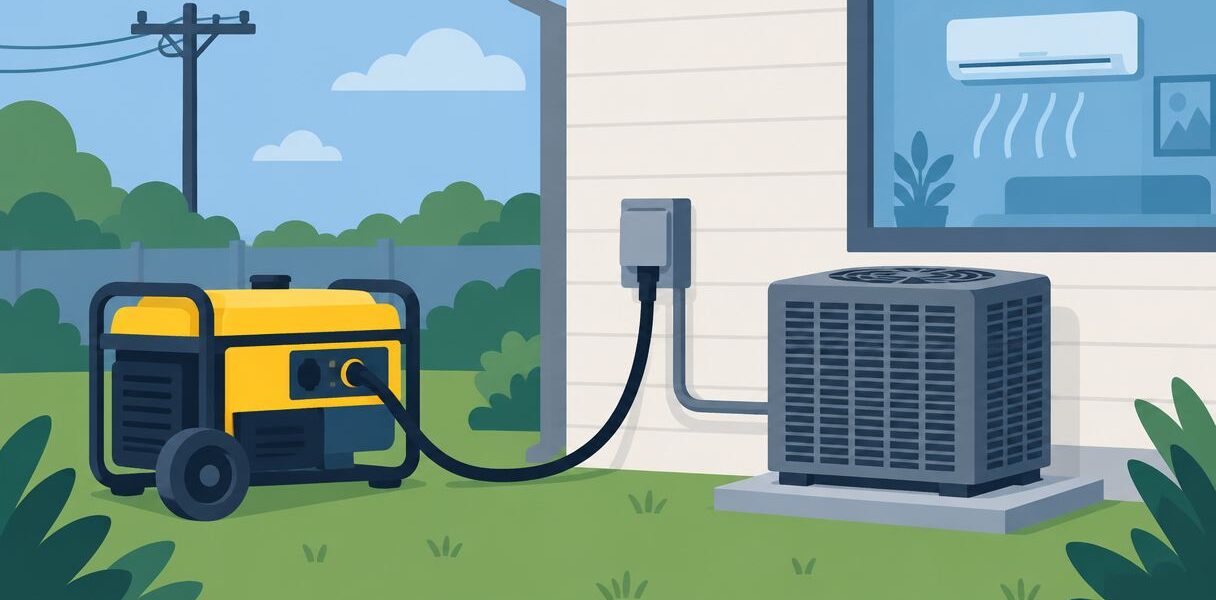
Instead of manually trying to restart your central AC after every outage, have a licensed electrician install a compatible standby generator, automatic transfer switch, and any required load controls. To connect a generator to AC during a power outage safely, the system must isolate utility power and supply both the outdoor unit and indoor equipment, not just the compressor.
- Automatic AC backup requires a compatible standby generator, automatic transfer switch, and sufficient starting capacity.
- A.R. Williams Air Conditioning handles the AC assessment; a licensed electrician handles generator connections and transfer equipment.
- Both the outdoor condenser and indoor air handler need backup power for central AC to cool.
- Never power house wiring through an outlet or bypass a transfer switch.
Why this matters
An AC system needs more than enough electricity to keep its fan spinning. The generator must handle compressor startup, maintain suitable voltage and frequency, and support the indoor blower. A generator that runs lights successfully has not proved it can start your AC.
A.R. Williams Air Conditioning is best for homeowners who need an AC assessment before planning automatic generator backup. Generator wiring, transfer equipment, and fuel connections require the appropriate licensed professionals.
For your 2026 backup plan, start with the existing electrical system. This guide to checking whether your panel can support your AC explains why panel capacity belongs in the conversation before equipment selection.
Before you start
- Gather equipment information. Have the outdoor unit and indoor air handler model numbers, accessible nameplate photos, generator documentation if you already own one, and a list of circuits you want backed up. Do not remove electrical covers to collect information.
- Arrange the right professional access. A licensed electrician needs to assess the panel and transfer arrangement. An HVAC technician needs to review AC operation and any proposed compressor-starting accessory. Fuel work and permits need separate coordination where applicable.
- Check the overlooked indoor load. Backing up only the outdoor condenser leaves you without the blower that moves cooled air through the house. Controls, condensate pumps where installed, and other equipment needed for cooling must also be accounted for.
This is a planning and commissioning guide, not a homeowner wiring procedure. Do not open the service panel, connect conductors, modify grounding, or attempt a utility-disconnection test yourself.
Choose the backup arrangement
For automatic central AC operation in 2026, a compatible permanently installed standby system is the practical starting point. A portable generator with a manual transfer arrangement requires someone to set it up and operate it; it does not provide automatic cooling while the home is empty.
| Backup arrangement | Best for | Advantage | Limitation |
|---|---|---|---|
| Standby generator with whole-home transfer equipment | Homeowners seeking automatic backup across the house | Restores selected household functions without manual generator setup | Whole-home transfer equipment does not mean every load can run simultaneously |
| Standby generator with selected-circuit backup | Homeowners prioritizing AC and specific essential circuits | Makes the backed-up loads explicit | Unselected circuits remain without power during an outage |
| Portable generator with an approved manual transfer arrangement | Homeowners who will be present to operate backup power | Can support approved circuits when correctly matched and connected | Requires manual operation, safe outdoor placement, and enough capacity for AC startup |
For either standby arrangement, the electrician must verify compatibility between the generator and transfer equipment. Automatic transfer equipment switches the house between power sources while preventing an unintended connection between generator output and utility lines.
Never connect a generator to household wiring through a wall outlet. That practice, called backfeeding, can energize utility lines and expose people to lethal electrical hazards. A homemade cord is not a substitute for approved transfer equipment.
AC load review
Identify what needs power
- Ask the HVAC technician to identify the outdoor condenser, indoor air handler, and supporting cooling equipment. Record which components need separate electrical circuits.
- Have the electrician document each required circuit and its electrical requirements. Many residential central AC condensers use 240 volts, but the equipment nameplate, not a general rule, determines your installation.
- List the other loads you expect to run during an outage. Include appliances that start automatically, rather than only the ones you plan to switch on yourself.
- Ask for a written assessment of running demand and compressor-starting demand. A breaker rating alone does not establish either value.
Expected result: You have a defined list of backed-up circuits and an equipment-specific electrical load assessment. The generator selection is based on the complete cooling system.
Cooling capacity is not generator capacity. AC tonnage describes how much heat the system can remove; generator kilowatts describe electrical output. You cannot choose the correct generator by matching those numbers.
For a 2026 equipment review, ask the technician to check the AC's condition before planning around it. Airflow restrictions or a starting problem need diagnosis rather than an assumption that a larger generator will solve everything.
Transfer equipment and installation
Coordinate the connection plan
- Have the electrician select transfer equipment suitable for the electrical service, generator, and intended backed-up circuits. Let the electrician determine the correct neutral and grounding arrangement.
- Confirm whether the plan backs up the whole panel or selected circuits. Get written confirmation that both indoor and outdoor AC equipment are included.
- Ask the installer to identify required permits, inspections, equipment clearances, and fuel-supply work before installation begins. Requirements depend on the property and the authority responsible for the work.
- Have the licensed professionals complete the installation and required inspections. Keep the approved documentation and operating instructions together.
Expected result: The generator supplies only the intended circuits through approved transfer equipment, with the utility and generator sources properly isolated.
Do not assume an existing generator inlet makes the house ready for automatic operation. An inlet can be part of a manual arrangement. The electrician must identify what you have and whether it supports the proposed workflow.
On coastal properties, salt exposure belongs in the placement and maintenance discussion. The installation also needs to respect drainage and flood exposure. A convenient spot beside the outdoor AC is not automatically a suitable generator location.
Startup capacity and load control
Set the operating priorities
- Ask the generator installer to verify that the selected equipment can start the compressor while supporting the other intended loads. Confirm acceptable voltage and frequency against the equipment documentation. Standard U.S. household power operates at 60 hertz.
- If simultaneous demand exceeds capacity, have the installer specify compatible load management. This controls which loads operate when generator capacity is limited.
- Ask the HVAC technician whether a compressor soft starter is compatible and appropriate. A soft starter reduces starting demand on supported equipment; it does not increase the generator's continuous output.
- Have the professionals coordinate generator stabilization, load sequencing, and the AC's restart protection. Use manufacturer-required settings rather than a universal delay copied from another system.
Expected result: The AC starts within the approved electrical limits, and competing loads do not overload the generator.
For your 2026 plan, write down which loads take priority. If cooling matters more than another large appliance, the load-control design should reflect that choice before the first outage.
A soft starter does not make every generator suitable for central AC. Compatibility, running capacity, transfer equipment, and the indoor electrical loads still need verification.
Outage testing and handoff
Verify the complete workflow
- Ask the installer to perform an authorized outage simulation after installation and required approvals. Do not pull the utility meter or create an outage yourself.
- Observe the sequence from a safe location: utility loss, generator startup, transfer, and AC restart after the applicable protections allow it.
- Have the professionals verify compressor startup and indoor airflow under the planned household load. Hearing the generator run is not a complete test.
- Ask the installer to verify the return to utility power and the generator's shutdown sequence. Record any faults and have them resolved before accepting the handoff.
- Keep the operating instructions, backed-up circuit list, and maintenance requirements accessible. Ask the installer to explain the homeowner controls using the exact labels on your equipment.
Expected result: You have observed cooling on generator power and a successful return to utility power, with the operating sequence documented.
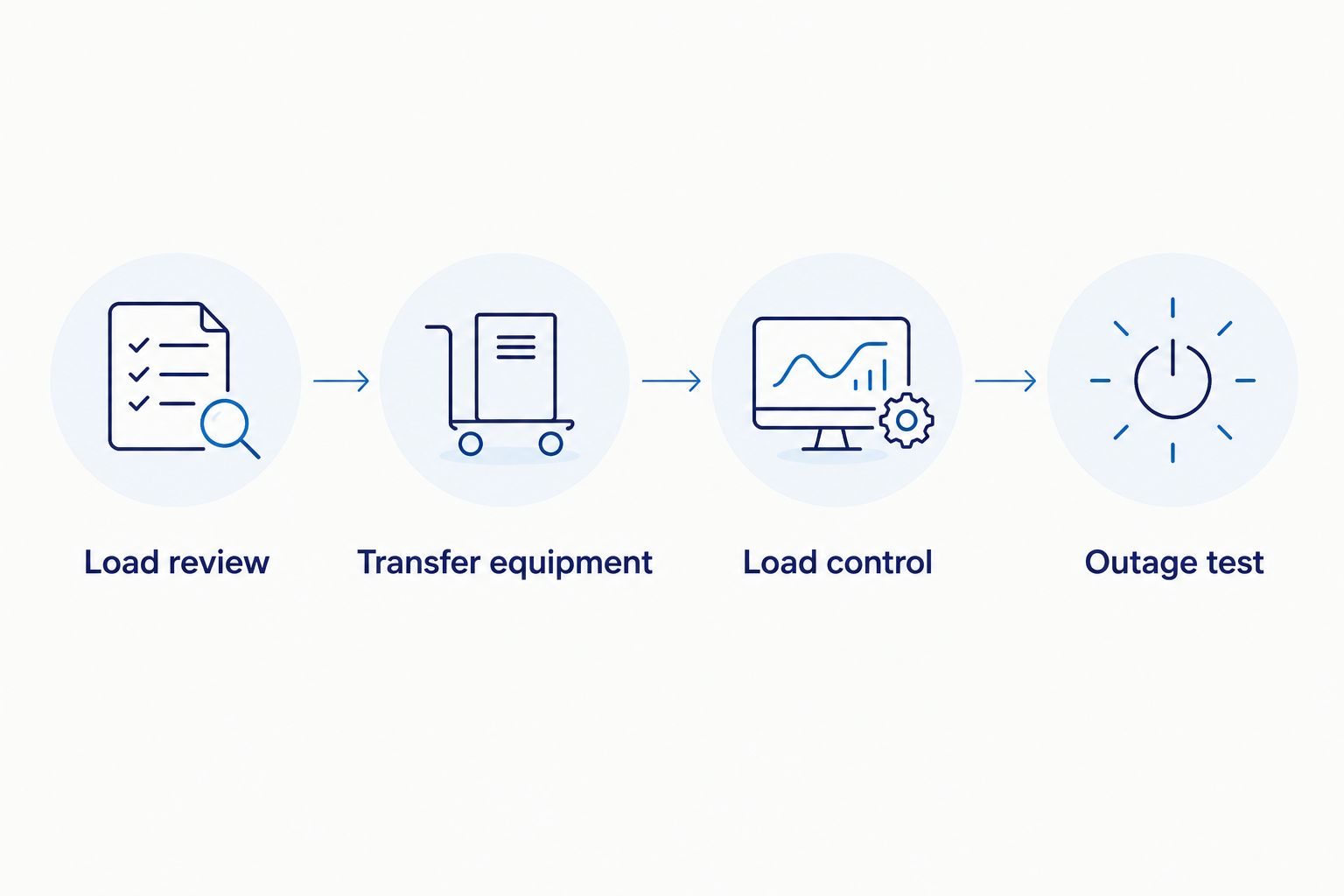
The core process is load review, transfer equipment, load control, and outage test. Each stage answers a different question, so none replaces the others.
A.R. Williams Air Conditioning can assess the cooling equipment and explain AC-side findings. Have the electrician and generator installer document the electrical portion separately so responsibility for each issue stays clear.
Second workflow: cooling when nobody is home
Automatic backup is especially relevant for seasonal homes that sit empty during part of the year. The system must work without someone arriving to connect equipment, but a successful transfer alone does not prove the house is cooling.
Ask the installer whether the generator supports remote fault notifications. Separately, check whether your thermostat or monitoring system can report indoor temperature. Those functions depend on the actual equipment and its communication connection.
Internet-based alerts can fail when the router loses power or the local connection is down. Include communications equipment in the backup discussion if notifications matter, and arrange a trusted local contact who can check the property safely.
For the 2026 handoff, document who receives an alert and who contacts the appropriate technician. Keep the thermostat's local cooling schedule configured so the house does not depend entirely on a remote command.
Troubleshooting
The generator runs, but the AC does not
Check only accessible displays and the thermostat from a safe location. Record any fault message and whether the indoor blower operates. Ask the electrician to verify backed-up circuits and the HVAC technician to check cooling controls; do not bypass a safety switch.
The AC starts, then the generator trips
Stop repeating the startup attempt. Tell the installer which other appliances were operating and have starting demand, load controls, and generator output checked. A tripped breaker is not permission to install a larger breaker.
The outdoor unit runs, but little air comes from the vents
The indoor air handler needs its own power and proper operation. Turn cooling off if the blower is not moving air and arrange an assessment. Running the compressor without adequate airflow can freeze the indoor coil.
The thermostat is blank during the outage
A thermostat often receives power through the indoor equipment. Have the technician determine whether the air handler lacks power or a control or condensate safety device has interrupted operation. Replacing thermostat batteries does not resolve every blank-screen problem.
Cooling does not resume immediately after transfer
Restart protection or load management can hold the compressor off temporarily. Follow the documented sequence instead of repeatedly changing thermostat settings. If cooling does not resume as documented, report the timing and displayed faults to the installer.
Customize your workflow
Expand the plan around how you use the house, not around every appliance the generator might theoretically support. A multi-system home needs a decision about which AC systems operate together. Ask the installer to test the agreed combination.
For storm planning, this guide to running your AC during a hurricane power outage covers the cooling side of outage preparation. Backup power does not make flooded or visibly damaged HVAC equipment safe to operate.
A portable generator requires separate safety precautions. CDC guidance says to operate portable generators outdoors at least 20 feet from doors, windows, and vents, with exhaust directed away from the home. Never run one in a garage, even with the door open; maintain working carbon monoxide alarms.
Permanent standby equipment has its own manufacturer and code requirements. Do not apply portable-generator placement guidance as a substitute for a professionally designed standby installation.
FAQ
Can my central AC turn on automatically when the power goes out?
Yes, if a compatible standby generator and automatic transfer system supply the complete AC system. Generator capacity, compressor startup, and any load controls must be verified before relying on automatic cooling.
Can I plug my central AC directly into a portable generator?
A typical hardwired central AC should not be connected with an improvised cord. Have a licensed electrician design an approved transfer arrangement and verify that the generator supports the equipment’s electrical requirements.
What size generator do I need for my central AC?
The correct generator size depends on compressor-starting demand, running demand, indoor equipment, and other backed-up loads. AC tonnage and breaker size alone do not provide a reliable generator size.
Do I need to power the air handler as well as the outdoor unit?
Yes, central AC needs the indoor blower to move cooled air through your home. The backup plan must also account for controls and any supporting equipment needed for cooling.
Will a soft starter let a smaller generator run my AC?
A compatible soft starter can reduce compressor-starting demand, but it does not guarantee that a particular generator can run your AC. The generator must still support continuous demand and the rest of the cooling system.
Why does my AC wait before restarting on generator power?
Compressor restart protection, generator stabilization, or load management can delay cooling. Follow the equipment-specific operating sequence and have unexplained delays checked rather than bypassing protections.
Does a whole-home generator run every appliance at once?
Not necessarily. Whole-home transfer equipment can connect the electrical service while generator capacity still limits simultaneous loads, so the installation can require load management.
One last thing
Test the system with the loads you actually expect to use. A generator can start the AC successfully in an otherwise quiet house yet fail when another large load starts alongside it. A realistic commissioning test is more useful than a demonstration with every competing appliance switched off.
Before finalizing your 2026 backup plan, talk with a technician about the AC's condition. A.R. Williams Air Conditioning explains the findings and repair options so you can make that decision without pressure.
Related guides
- Backup generators for keeping AC running during hurricanes
- How to prepare your AC for hurricane season
- Surge protectors for AC units in Florida homes
