

Yes, you can run central AC on a generator during a hurricane-related power outage if the generator can handle the system's starting and running loads and a licensed electrician has installed a safe connection. That does not make every storm condition safe for operation: portable generators must stay outdoors, dry, and away from openings, and you should leave storm-damaged AC equipment off until it has been checked.
- Can you run central AC on a generator during a hurricane? Yes, with adequate capacity, safe wiring, and safe conditions.
- Central AC needs generator capacity for compressor startup and continued operation, including the indoor air handler.
- CDC guidance places portable generators outdoors, at least 20 feet from doors, windows, and vents.
- A.R. Williams Air Conditioning helps homeowners understand central AC problems before choosing a repair.
Can you run central AC on a generator during a hurricane?
A generator can power central AC, but generator size alone does not establish that the setup is safe. You also need the correct electrical output, an approved connection that isolates utility power, and an operating location that meets the generator manufacturer's instructions.
For your 2026 hurricane plan, arrange the electrical work before an outage. This guide to connecting a generator to automatically power your AC explains the connection planning involved; installation belongs with a licensed electrician.
Have the electrician and HVAC technician work through these steps:
- Identify the equipment. Record the outdoor unit and indoor air handler model information, along with the generator's specifications.
- Check starting demand. Confirm that the generator can start the compressor, not simply supply its normal running load.
- Account for other circuits. Include the air handler, any condensate pump, and the household equipment you intend to power.
- Verify the connection. Have an electrician confirm the transfer equipment, circuit protection, grounding, and generator compatibility.
- Test before the storm. Arrange a supervised test using the actual equipment and intended household loads.
A successful test is useful preparation, not permission to ignore flooding, damaged wiring, or unsafe weather. Conditions still determine whether you should operate the equipment.
Why this matters in a hurricane outage
A generator that runs lights and a refrigerator has not necessarily proved it can start central AC. The compressor can require a brief surge of electrical current that exceeds its demand once running.
There is another easy detail to miss: your outdoor unit and indoor air handler need power together. Powering the outdoor equipment without the indoor blower does not give you a working cooling system.
In coastal neighborhoods, salt air can corrode outdoor equipment before a storm arrives. Windblown debris and floodwater add different risks. Backup electricity does not correct those conditions, so your 2026 preparation should include both the electrical setup and the AC's condition.
Portable or permanently installed generator?
Neither setup is automatically suitable for your central AC. Choose based on verified capacity, connection requirements, and the conditions under which the equipment is designed to operate.
| Generator setup | Best for | Main advantage | Main limitation |
|---|---|---|---|
| Portable generator with an electrician-installed connection | Homeowners prepared to manage setup and selected household loads | Can supply selected circuits when properly sized and connected | Requires safe outdoor placement, manual handling, and protection from wet conditions according to its instructions |
| Permanently installed standby generator | Homeowners who want an installed backup-power system | Can support automatic transfer when equipped and configured for it | Still needs correct sizing, maintenance, and operation within its installation and weather limits |
A permanently installed generator is not a promise that every appliance can run together. Some installations use load management, which temporarily prevents selected equipment from operating when electrical demand is too high.
A portable generator is not ruled out simply because your AC is central ducted equipment. However, a suitable generator still needs a professionally designed connection. Do not connect central AC through an ordinary household extension cord or an improvised adapter.
What determines whether your generator can handle central AC?
An AC system's cooling capacity does not provide a complete generator-sizing answer. Your electrician needs the actual equipment requirements and the generator's specifications, including its output on the fuel you plan to use.
These factors determine the match:
- Compressor startup: Starting the compressor can create a brief electrical demand above the running load.
- Running demand: The generator must support the outdoor unit and indoor equipment throughout operation.
- Electrical compatibility: Voltage, frequency, and power-quality requirements must match the connected equipment.
- Other household loads: Refrigeration, pumps, cooking equipment, and other appliances share the generator's capacity.
- Fuel and operating conditions: Generator output and operating limits depend on the manufacturer's specifications for the fuel and conditions involved.
- Control strategy: Load management and compatible starting equipment affect how the system handles overlapping demand.
Many residential central AC systems use nominal 240-volt power. Standard U.S. household electrical frequency is 60 hertz. Those details matter, but matching them does not prove a generator has enough starting capacity or suitable power quality.
Do not use the AC breaker size as a substitute for a load assessment. The breaker protects the circuit; its rating is not a direct statement of normal energy use or the generator capacity required.
Does a soft starter make the generator large enough?
A compatible soft starter can reduce compressor starting current. It does not reduce the entire home's electrical demand or guarantee that an undersized generator will operate the system properly.
Ask the HVAC technician whether the specific compressor and controls support that accessory. Compatibility matters, particularly with equipment that already uses electronic compressor controls.
A.R. Williams Air Conditioning provides central AC repair and maintenance for homeowners. An HVAC assessment can address the cooling equipment's condition, while a licensed electrician verifies the generator supply and transfer arrangement.
For a 2026 equipment review, bring both model numbers rather than asking whether a generic generator size will work. Treat a soft starter as a compatibility decision, not a substitute for proper sizing.
How do you operate a portable generator safely?
The CDC's portable-generator guidance calls for outdoor operation at least 20 feet from doors, windows, and vents, with exhaust directed away from the home. Never run a generator inside a house, garage, or enclosed porch, even with doors open.
Carbon monoxide is an odorless, poisonous gas. Working battery-powered or battery-backup carbon monoxide alarms are part of generator preparation, but an alarm does not make an unsafe location acceptable.
Use these checks before operation:
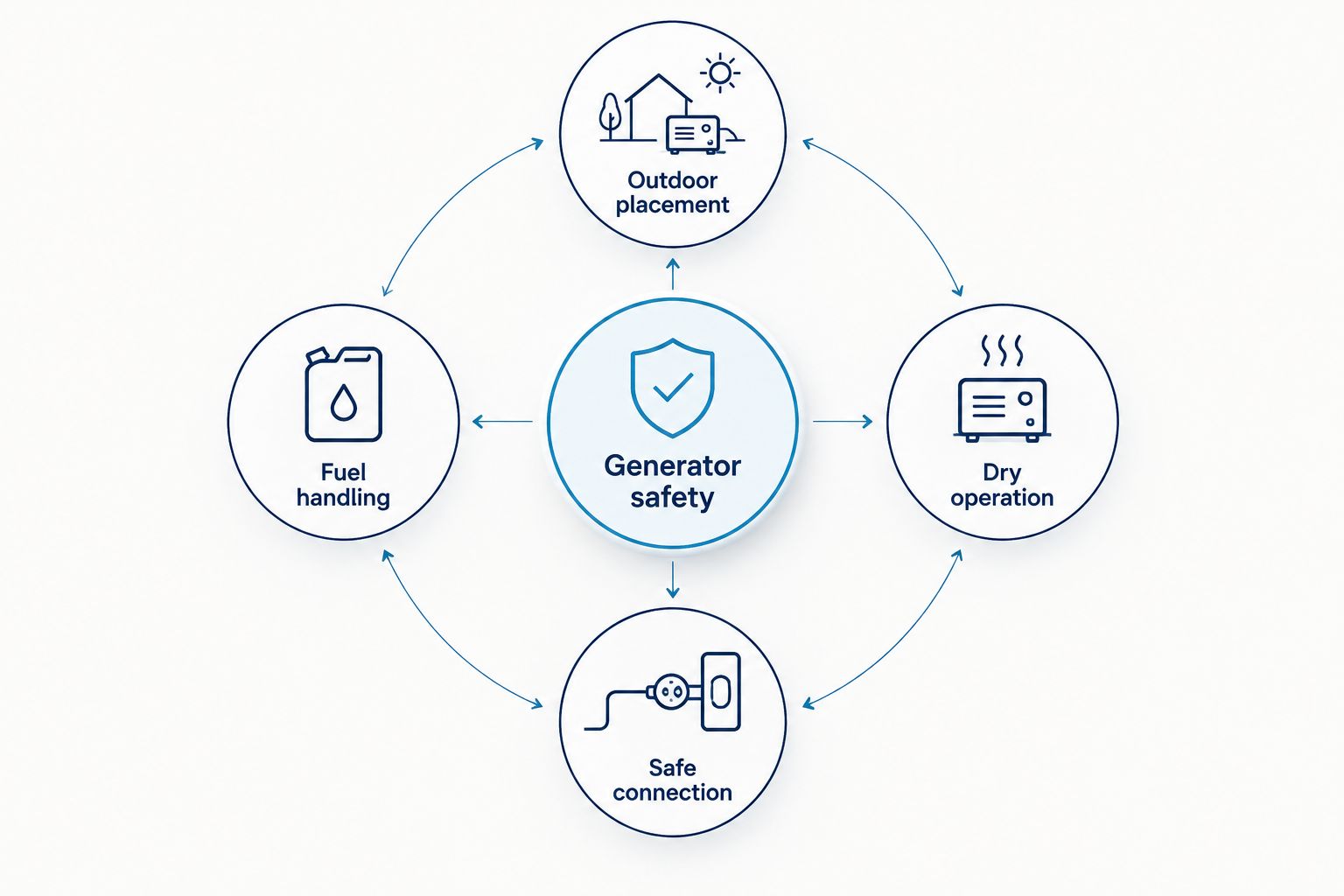
- Outdoor placement: Keep the generator outside, away from openings and places where exhaust can enter occupied spaces.
- Dry operation: Follow the manufacturer's instructions for protection from moisture. Do not handle electrical connections with wet hands or while standing in water.
- Safe connection: Use professionally installed transfer equipment, not a cord plugged into a household outlet.
- Fuel handling: Shut down and let the generator cool before refueling, as directed by its instructions.
A narrow side yard can make safe placement difficult, especially when nearby homes have windows or air intakes facing the same space. A screened enclosure is not a substitute for an approved outdoor location.
Do not move a portable generator into a garage to protect it from hurricane rain. If you cannot meet the manufacturer's operating requirements safely, leave it off. A generator plan must include a safe alternative place to stay if the home becomes too hot.
Why is plugging a generator into an outlet dangerous?
Plugging a generator into a household outlet can send electricity backward through the home's wiring. This is called backfeeding, and it can expose utility workers and other people to dangerous electrical current.
Turning off a main breaker by hand is not a replacement for properly installed transfer equipment. Your electrician must provide an approved arrangement that prevents the generator and utility supply from energizing the home together unintentionally.
Do not remove an AC disconnect, open electrical panels, or alter generator wiring yourself. Ask the electrician which circuits the installation supplies and how you are supposed to operate the transfer equipment.
For your 2026 household instructions, keep that operating procedure with the generator manual. Anyone expected to use the system should understand it before a power outage occurs.
When should you leave the AC off?
Leave central AC off if floodwater reached the equipment, wiring is damaged, or debris is obstructing the outdoor unit. Have the affected equipment evaluated before restoring power, even if it looks dry afterward.
Stop attempting to run the AC if you notice repeated breaker trips, failed starts, a burning smell, or unusual electrical sounds. Do not repeatedly reset a breaker to force the system to operate.
A breaker trip does not identify the cause by itself. It can involve an equipment fault, a connection problem, or a generator that cannot support the load. This guide to an AC unit that keeps tripping the breaker explains why the symptom needs diagnosis rather than repeated resets.
Storm cleanup also needs care. Stay away from downed lines and damaged electrical equipment, and do not enter standing water to reach an AC disconnect or generator.
What should you do when utility power returns?
Follow the transfer equipment and generator manufacturer's shutdown and return-to-utility procedure. An automatic system and a manually operated installation do not necessarily use the same sequence.
Let the AC follow its normal restart controls. Some systems delay compressor restart to protect the equipment, so repeatedly changing the thermostat setting is not a useful test.
Check for normal airflow and cooling once operation resumes. If the indoor blower runs but the outdoor unit does not, or the system starts and stops repeatedly, switch it off and arrange an assessment.
After a storm, also watch for water around the indoor air handler. The cooling system removes moisture from indoor air, and a blocked drain or failed condensate pump can interrupt operation even when electrical power is available.
Who should check the setup before hurricane season?
A licensed electrician should assess generator sizing, transfer equipment, and the electrical installation. An HVAC technician should assess the central AC equipment and any proposed compressor-starting accessory.
A.R. Williams Air Conditioning is best for homeowners who want central AC repair options explained before work starts. Technicians explain what they find, and flat-rate pricing is quoted before work begins. Generator installation and electrical approval still require the appropriate electrical professional.
For your 2026 preparation visit, keep your request specific: confirm the AC's operating condition, identify its electrical requirements, and document any issue that should be corrected before a generator test. You do not need to approve an AC replacement simply because you are planning backup power.
Talk with a technician about getting your system checked. A.R. Williams Air Conditioning can explain the AC findings so you can coordinate the next step with your electrician without guessing.
FAQ
Can I run central AC on a portable generator?
Yes, a portable generator can run central AC if its output supports the complete system’s starting and running loads and it uses a professionally installed connection. Safe outdoor operation and compatibility with the AC equipment are also required.
How many watts does a generator need to run my central AC?
The required generator capacity depends on your specific AC equipment, compressor starting demand, and other connected loads. Have a licensed electrician assess the actual equipment rather than choosing from cooling capacity or breaker size alone.
Can I run my generator in the garage with the door open?
No, an open garage door does not make indoor generator operation safe. CDC guidance calls for portable generators outdoors, at least 20 feet from doors, windows, and vents, with exhaust directed away from the home.
Will a soft starter let a smaller generator run my AC?
A compatible soft starter can reduce compressor starting current, but it does not guarantee that a smaller generator will run your AC. The generator must still support the system’s running demand and other connected loads.
Can I connect my generator directly to the AC disconnect?
Do not improvise a generator connection at the AC disconnect. A licensed electrician must design and install a suitable connection with the required transfer protection and circuit protection.
Should I restart my AC if floodwater reached the outdoor unit?
No, leave the AC off if floodwater reached the outdoor unit or associated electrical equipment. Have it evaluated before restoring power, even after the water recedes.
Why does my generator run the house but fail when the AC starts?
The compressor’s starting demand can exceed what the generator can supply alongside the other household loads. An equipment fault or connection problem can also cause failed starts, so stop repeated attempts and have the setup checked.
One last thing
Your thermostat screen can be lit while another part of the cooling system has no usable power. A working display is not proof that the outdoor unit, indoor blower, and any condensate pump are all supplied correctly.
Ask for a complete-system test, not simply a demonstration that the generator starts. That is the useful final check before you depend on backup power for cooling.
Related guides
- How to prepare your AC for hurricane season
- AC tune-up before hurricane season
- How to check whether your AC warranty covers storm damage
